Greece Luxury Villas: How to Choose the Right One
Compare Greece luxury villas by region, property style and trip needs, then run seismic, water and legal checks before you book your stay.
Greece's luxury-property market carried an estimated €800 million to €1 billion in annual transaction volume in 2025, based on a survey of more than 250 high-net-worth and ultra-high-net-worth buyers published by Greece Sotheby's International Realty. Buyers at that level don't shop on photographs. Renters paying five figures a week shouldn't either.
A villa in Greece is a building on a seismic map with a water tank, a generator, a registration number and an approved occupancy limit. Most guides to Greece luxury villas rank sea views and infinity pools. This one ranks documentation first, because a house that photographs beautifully and fails on the third day of a wedding isn't a luxury property. It's an expensive problem. Here's how to choose the region, the property style, and a villa you can stand behind.
Greece Luxury Villa Regions Compared
Pick the region before you look at a single villa. Geography sets your transfer times, your peak-season price and your exposure to water shortages more than any interior designer does. Four regions carry almost all of the premium rental market, and each one solves a different problem for a different traveller.
The demand behind them isn't speculative. Greece recorded 36.0 million inbound tourist arrivals in 2024, up 9.8% from 32.7 million in 2023, and inbound tourism receipts excluding cruise revenue reached €20.6 billion, according to the Institute of the Greek Tourism Confederation's tourism analysis. A market that size has enough stock to let you be selective, which is exactly why you should be.
| Region | Best for | Main trade-off |
|---|---|---|
| Cyclades (Mykonos, Santorini) | Beach clubs, nightlife, celebrations | Peak-season prices and high water demand |
| Crete | Large families, varied landscapes, longer stays | Long distances between areas and transfers |
| Ionian Islands | Privacy, green coastlines, sailing | Weather-dependent shoulder season and fewer year-round services |
| Athenian Riviera | Short trips from Athens, executive retreats | Coastal traffic and closer urban setting |
The Cyclades reward groups who want the trip to happen outside the villa: beach clubs, restaurants, a wedding venue twenty minutes down the road. They punish planners on price. August rates are set by scarcity rather than quality, and late-June rates typically sit well below the August peak. Book early in the season if the calendar allows it, and put the savings into a better-specified house: larger water storage, backup power, more staff.
Crete is the answer for multigenerational groups and two-week stays, because it has the airports, hospitals and road network that small islands lack. Its trade-off is horizontal. Chania to Elounda is a long drive across the island, so pick one coast and stay on it. A group that splits the fortnight between both ends loses days to transfers.
The Ionian Islands suit privacy, sailing and green coastlines, with a shoulder season that lives or dies on the weather. Buyer demand shows the pressure: luxury-property inquiries in Corfu rose 91% in 2025, with a median property price of €2.6 million at €5,486 per square metre, per JamesEdition. Rental stock tightens when buyers move in, so the better villas get reserved earlier each year.
The Athenian Riviera wins on time. It sits far closer to Athens airport than any island, so a seafront villa for a three-night executive retreat beats a two-hop island transfer every time. Accept the traffic and the neighbours.
Practical rule: choose the region by travel time and purpose first, then shortlist villas inside it. Use the trade-off column to rule a region out, never to talk yourself into one.
Couples planning a milestone trip usually land in the Cyclades for good reason, and the version that works is one base plus day trips rather than three islands in seven days (ideas for a 10 year anniversary vacation).
Property Styles That Suit Each Group
Building type decides how a property feels on day three, once the view has stopped surprising you. Five styles cover most of the Greek rental market, and each carries one operational trade-off worth naming before you book.
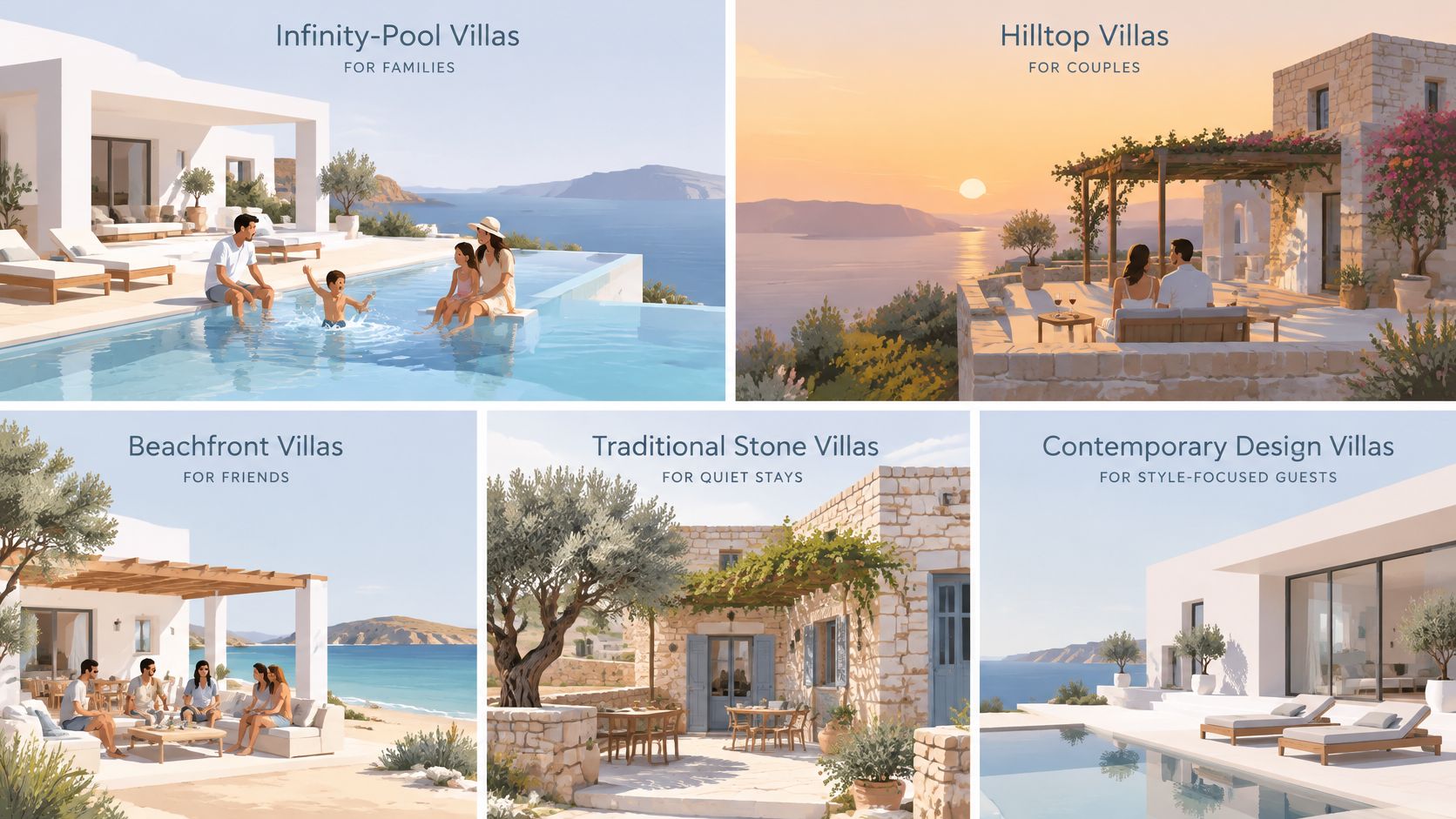
- Infinity-pool villas suit families and celebrations, where the pool becomes the group's centre of gravity. The trade-off is service: ask who maintains it and how many visits a week the contract includes. A green pool in August has no fix.
- Clifftop modern villas deliver the privacy and the photograph everyone wants. The trade-off is access: steep steps, no lift, a lane a minibus can't turn in. Test it against a 1am arrival with luggage.
- Traditional stone houses put you inside a village and a culture rather than above it. The trade-off is construction age, which makes documented structural history a condition of booking rather than a nice extra.
- Beachfront villas remove the daily logistics of reaching the sea. The trade-off is exposure: wind, salt and weather decide whether the terrace is usable, and the Meltemi doesn't negotiate.
- Walled estates with resident staff host executive teams and weddings because staffing and permissions define what the property can do. The trade-off is that capacity is a legal number, not an impression.
Honeymooners should shortlist privacy and sea-facing orientation first and treat everything else as secondary, since the property is the destination rather than the base (honeymoon destination ideas).
Three questions that predict day three
Ask these before you commit. The answers tell you more than sixty photographs.
- How many bedrooms share one bathroom? Two is workable for a family. Three is a queue at 7pm, every evening.
- How far is the nearest swimmable beach by road? Map distance lies. A 900-metre path down a cliff isn't access.
- Do staff live on site or commute? Live-in staff solve a 6am problem. Commuting staff solve a 10am one.
Ask them in writing, and ask the same three questions of every property on the shortlist. The answers rank the villas faster than any gallery.
Matching the Villa to Your Trip Needs
Photographs don't tell you whether a house can hold your trip. Trip type does, because each one stresses a different part of the property, and the stress points are rarely the ones the listing mentions.
| Trip type | Must-have feature | Check before booking |
|---|---|---|
| Family reunion | Bedrooms and fenced pool | Verified occupancy per bedroom |
| Wedding | Outdoor event space and generator backup | Permitted event use and terrace capacity |
| Corporate retreat | Meeting room, reliable Wi-Fi and parking | Confirmed occupancy and on-site staff |
| Honeymoon | Privacy and sea-facing views | Sunset orientation and road access |
| Multi-villa group | Adjacent villas and shared transfers | One supplier coordinating all properties |
Family reunion. Bedrooms and a fenced pool are the entry ticket. The check is verified occupancy per bedroom, because a house marketed for twelve that sleeps eight in real beds and four on sofa beds changes the mood of the entire week. Greek licensing attaches occupancy to the property as a number, not a suggestion.
Wedding. You need outdoor event space and generator backup, and you need to verify permitted event use and terrace capacity. A villa cleared for eight overnight guests is not cleared for a 60-person dinner, and a pool deck approved for sun loungers isn't approved for staging, catering equipment and a band. Ask what the terrace is rated to carry, in writing.
Corporate retreat. A meeting room, working Wi-Fi and parking sound basic until you've tried to run a morning session on a mobile hotspot. Confirm occupancy and on-site staff, because an executive team wants breakfast at 7am and a car at 8am, not a housekeeper who arrives at 10.
Where planners cut corners
Honeymoon. Privacy and sea-facing views matter, but the check is sunset orientation and road access. West-facing matters in Greece, and so does whether the last 800 metres is asphalt or a dirt track a transfer car refuses after dark.
Multi-villa group. Adjacent villas and shared transfers, coordinated by one supplier across every property. Five separate bookings produce five arrival times, five deposits and nobody accountable when one villa's air conditioning fails on the wedding morning.
Trade-off to accept: one coordinator with slightly less choice beats five brokers with perfect choice. Groups lose more evenings to coordination than to a villa 300 metres further from the beach.
If the group wants a day on the water, book one charter through that same coordinator rather than a boat per villa (private yacht charters in Greece). Let trip type build the shortlist, then let the checks eliminate.
Checking Seismic Safety Before You Book
A renovated interior proves someone spent money. It doesn't prove the building will behave in an earthquake. Greece sits in a seismic region, and the villa you're considering is a structure first and a holiday home second.
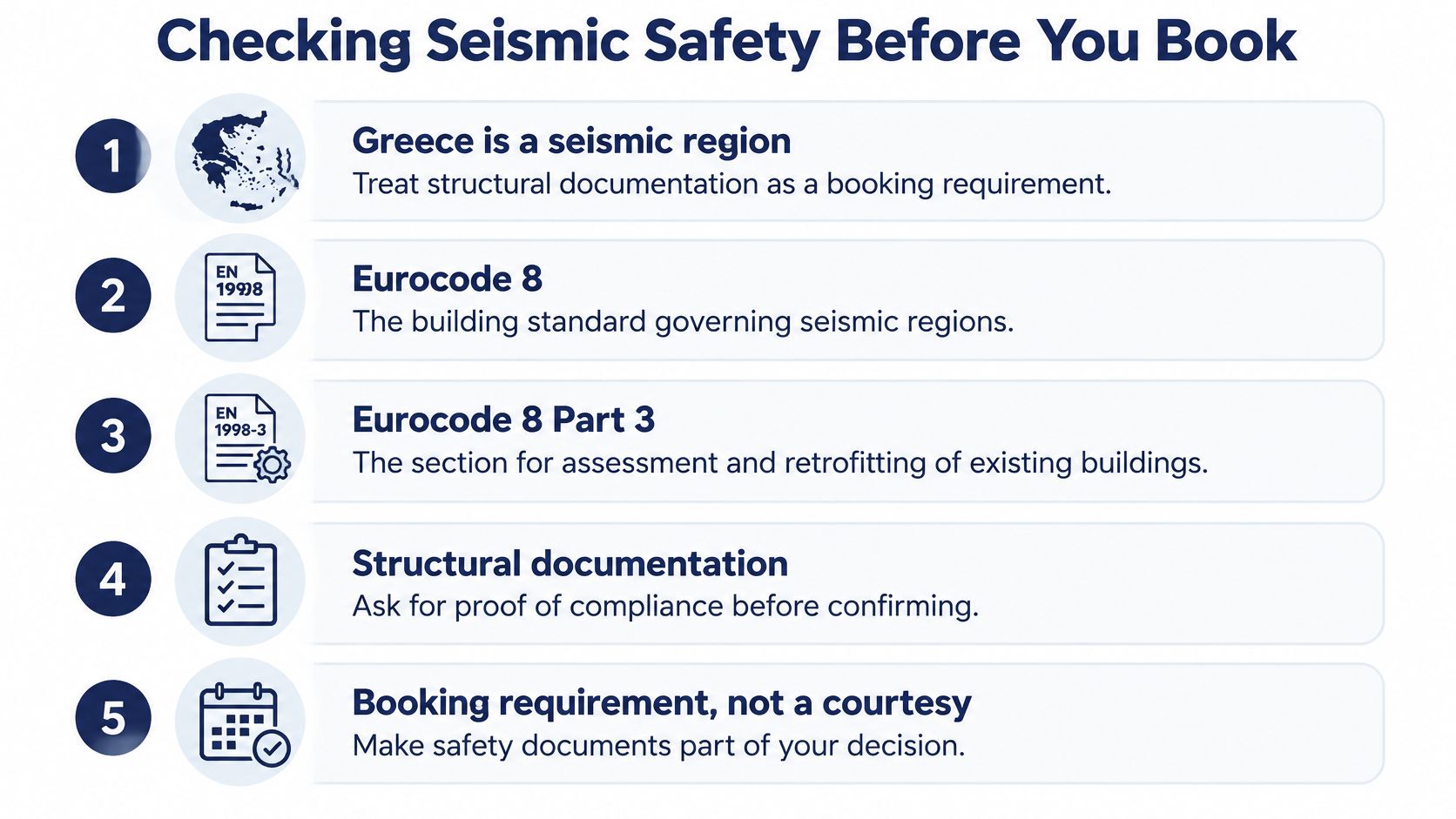
Eurocode 8 governs the design of buildings in seismic regions. The Eurocode 8 framework published by the European Commission's Joint Research Centre is built to protect life, limit structural damage and keep civil-protection structures operational, covering seismic actions, structural analysis, ductility and deformation control. Part 3 is the section that matters when you're renting an existing villa: it sets out how to assess a standing building and how to select and design retrofit measures for concrete, steel, timber and masonry.
Villas are the hard case, not the easy one. Open-plan ground floors, cantilevered terraces, retaining walls and heavy water features all alter stiffness, mass distribution and load paths. An infinity pool is tonnes of water sitting where an engineer may never have modelled it.
The five-item documentation request
- Structural drawings and the construction date. If nobody can produce them, that's an answer in itself.
- Records of prior alterations, including glazing changes, rooftop additions and pool works.
- A seismic assessment by a qualified engineer, dated within recent years and signed.
- The approved occupancy limit, plus terrace and pool-deck capacity.
- Emergency egress routes and post-earthquake utility shutoff procedures, written down and shown to you on site.
Greek practice layers a national annex onto Eurocode 8 and uses the Greek Seismic Interventions Code, KANEPE, for structural interventions, where assessment works to performance objectives, data-reliability levels and target displacement parameters (ELOT). The consequence is blunt. "Renovated" is not a technical description, and thick stone walls or a recent concrete pour prove nothing on their own.
The distinction to hold onto: cosmetic renovation versus verified structural upgrading. One has a paper trail with an engineer's signature. The other has photographs.
Confirming Water and Power Reliability
Ask the question no listing answers. Will water, cooling and sanitation hold at 6pm on 10 August with fourteen people in the house?
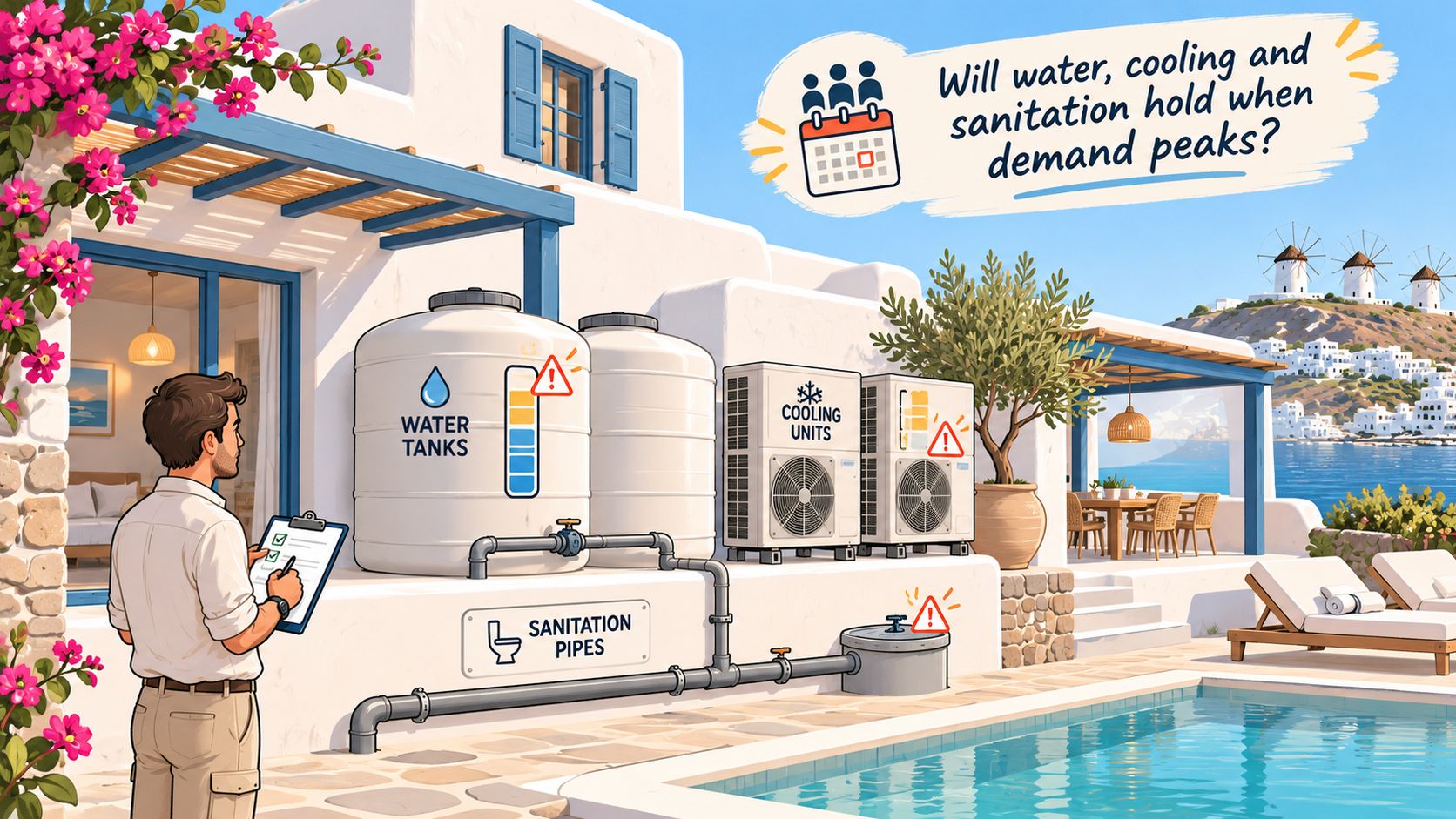
On Mykonos, daily water consumption rises from approximately 1,600 to 2,000 cubic metres in winter to 10,000 to 18,000 cubic metres in summer, up to nine times higher, as To Vima reports. Luxury-hotel guests may use around 1,000 litres per person per day, more than twice the estimated 450 litres for basic accommodation. A large pool and a full house draw on the same stressed supply, and the failure mode isn't ethical. It's a cold shower before a wedding.
What to ask before you sign
- Backup tanks and capacity. How many cubic metres, and are they topped up daily or weekly?
- Desalination dependence. Does the property buy tanker water, and who pays when the price spikes?
- Generator capacity. Sized for lights, or sized for pumps, air conditioning and a catering kitchen at once?
- Pool replenishment policy. Who authorises a refill, and what happens under drought restrictions?
- Wastewater system. Septic, connected, or a holding tank with a collection schedule?
- Event contingency. If supply fails during a 60-person dinner, what's the plan and who executes it?
Put the answers in the booking file. A verbal assurance from an owner who lives abroad is not a contingency plan.
The contrarian point: the most luxurious villa on the island may not be the one with the largest pool. It's the one with verified resilience and lower water intensity.
Greece announced more than 100 water-supply and desalination projects across 61 island municipalities in 2025, which tells you infrastructure capacity is now a destination-selection variable rather than a sustainability footnote, according to To Vima's reporting on island water.
Verifying Registration and Peak-Season Availability
A registration number in the listing that doesn't match the official register is a stop sign, not a negotiation. Verify first, shortlist second.
Greece's rental calendar is a funnel. Short-term-rental declarations rose 7.1% in 2025 and lease days rose 4.7%, but 68.1% of annual rental days fell between June and October, with August alone accounting for 18.8%, according to Hellenic Statistical Authority data. Peak villas go first, and the same villa runs on a different staffing model in May than it does in August.
The checks, in order
- Confirm the registration number is current and appears in the official register. Ask for the number itself, not a screenshot of a listing.
- Check that the property meets Greece's current minimum standards for short-term rentals, covering primary-use status, natural light, ventilation and air conditioning.
- Establish what you're booking. A private villa and a formally serviced residence are regulated and insured differently, and the paperwork should state which one you're signing.
- Confirm staffing and maintenance continue outside August. The chef who works in July may not exist in May.
- Verify transfer and supplier partners. A driver who knows the property gate saves an hour on arrival night.
The third point deserves weight. A serviced residence carries a duty roster and a manager on call. A private villa is an owner, a cleaner and a group chat. Both can be excellent, but only one has someone contractually responsible when the air conditioning fails at midnight.
Where regulation helps you: fewer listings is a feature, not a loss. The remaining ones have been through a filter that doesn't exist in unregulated markets.
Expect the count to keep moving. Central Athens shed thousands of active registration numbers once restrictions landed, even as nationwide short-term-rental revenue kept climbing. Stronger rules narrow the visible choice and raise the average quality of what's left. Book early, verify early, and treat a shortlist of six verified villas as stronger than a shortlist of thirty.
Briefing Your Planner Before You Book
Give a planner four inputs and you'll get a shortlist worth reviewing. Give them a mood board and you'll get ten villas with pools.
Send your dates, your group size, the trip type from the table above, and the region you've chosen. Add the one must-have feature that trip demands, plus any hard limits on guest count, event size or budget. That's a brief someone can work with.
What to ask for on every shortlisted villa
Ask the same five things of every property, and compare the answers side by side.
- Proof of registration, with the number checked against the register.
- Structural drawings and a recent seismic assessment, including any recorded alterations.
- Water and generator backup, with tank capacity and what the generator runs.
- Pool replenishment policy, in writing, including drought restrictions.
- Cancellation and deposit terms, plus confirmed staffing for your specific dates.
A shortlist where three villas can produce all five documents is stronger than a shortlist of ten where none can. That's the filter doing its job.
Timing follows the calendar. June to October bookings should start early, and shoulder-season dates should have staffing confirmed in writing before payment goes out.
Little Blue Door, a luxury travel and events agency, arranges luxury villa rentals alongside private yacht charters, and our supplier network includes villas, chauffeurs and experience providers around the world, so one coordinator runs these checks across the whole shortlist and handles transfers and supplier coordination on the ground.
Send your dates, group size and trip purpose, and the first reply should be a region recommendation plus the questions we'll put to each owner. That's a better use of your first week of planning than scrolling.
A villa that passes the structural, water and registration checks is the difference between a holiday that photographs well and one that holds together. Little Blue Door builds Greece trips around exactly that standard, pairing verified villa rentals with yacht charters, private aviation and ground coordination for families, executives and celebration groups. Tell us your dates, group size and trip purpose, and we'll come back with a region recommendation and a shortlist we've already interrogated. Start at Little Blue Door.