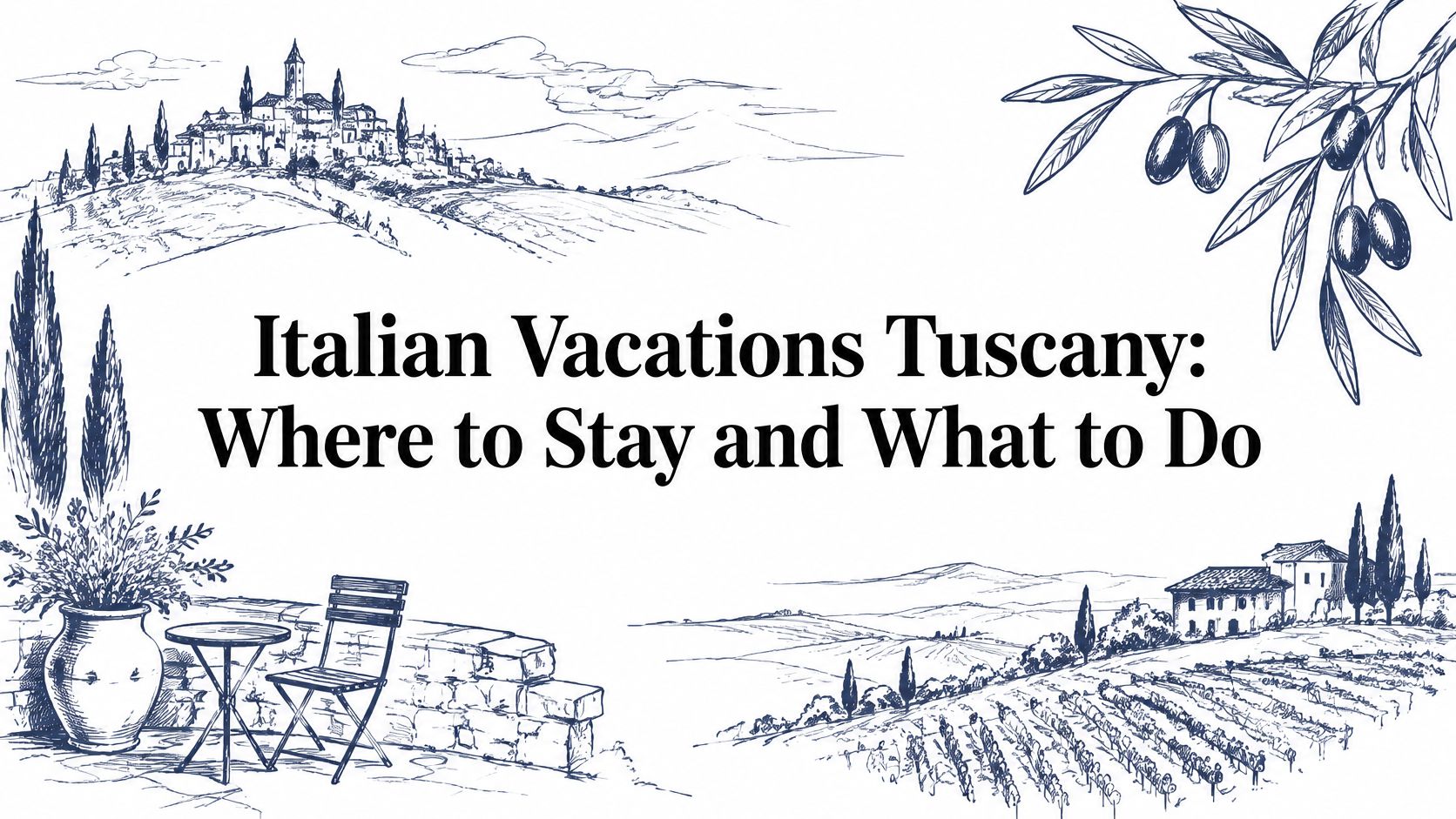
Italian Vacations Tuscany: Where to Stay and What to Do
Plan your Italian Vacations Tuscany trip: best bases, where to stay, wine estates, getting around and a sample seven-day route.
Have you chosen a beautiful Tuscan villa without checking how you'll get back from dinner? That's the gap in many Italian vacations: Tuscany looks compact on a map, but a convenient town and an accessible countryside property aren't the same thing. The best trips start with a base that suits your interests, then account for the final journey to every hotel, winery and restaurant.
Car-free luxury is entirely workable, but it requires coordinated ground transport. Choose where you want to spend your evenings, decide which experiences deserve a dedicated journey, and book the connections that public transport can't reliably provide.
Pick the Right Tuscan Base for Your Trip
Choose your base town first, then build the trip around it. Start with the place that supports your main interest, whether that's Renaissance art, family cycling or winery visits. A remote property picked for its photos will fight every dinner reservation and museum slot you try to keep.
Base towns compared for a Tuscany trip
| Base town | Best for | Getting around |
|---|---|---|
| Florence | First visit, museums, rail links | Walk, tram, train |
| Siena | Medieval streets, day trips | Walk the old town; bus or driver beyond it |
| Lucca | Walled town, cycling, family pace | Bike and walk inside the walls |
| Greve in Chianti | Wine estates, rolling hills | Car or driver; no rail station in town |
| Montalcino | Brunello, Val d'Orcia views | Car or driver for wineries and rural sightseeing |
Florence is the practical arrival point for all five bases. Siena and Lucca connect to it by scheduled bus and regional train, so a car-free first night is easy to arrange. Greve and Montalcino sit off the rail network entirely: reaching them means a road transfer you should price and book before you land, and the same applies to every winery lunch and hilltop dinner afterward.
Treat every journey estimate as an address-to-address calculation. The mileage to your gate matters more than the distance between two town halls, and a station arrival still leaves the walk, taxi ride or luggage transfer to your accommodation. Ask for the exact arrival point and access instructions before judging a connection comfortable. The return leg after a late dinner is the journey most likely to go wrong.
Choose the evenings you want
Florence suits travelers who want museums by day and restaurant choices on foot at night. It's the strongest starting point if you'd rather organize a few countryside excursions than drive for the whole holiday.
Siena offers a different urban experience, built around medieval streets, Piazza del Campo and the city's Palio tradition. Choose it for evenings in Siena itself; its position in the middle of a regional map is a weak reason on its own.
Lucca works well for families who value cycling, manageable walks and quieter evenings. Its appeal is the daily rhythm: you can go out without turning every activity into a transport arrangement.
Decide how much countryside privacy is worth
Greve in Chianti makes sense when wine estates and rolling hills are the reason for traveling. Montalcino is a more focused choice for Brunello and the Val d'Orcia. The privacy you gain at the property is paid for in transfer arrangements, so budget a driver for winery days and any dinner beyond walking distance rather than improvising on the night.
For a milestone trip, apply the same priorities you'd use when choosing the best vacation for a wedding anniversary: decide whether you want shared activities, privacy or effortless evenings before comparing rooms. A travel designer such as Little Blue Door can then coordinate the whole layer, since its itineraries combine accommodation, private transfers, curated activities and restaurant reservations with support throughout the trip.
Base-selection rule: Choose the place that supports your main interest, then add a contrasting base only if it changes the experience meaningfully.
A city-and-countryside pairing usually delivers more variety than moving between similar hill towns. Two bases tend to be enough; each hotel change should earn its place.
Getting Around Tuscany Without Driving Yourself
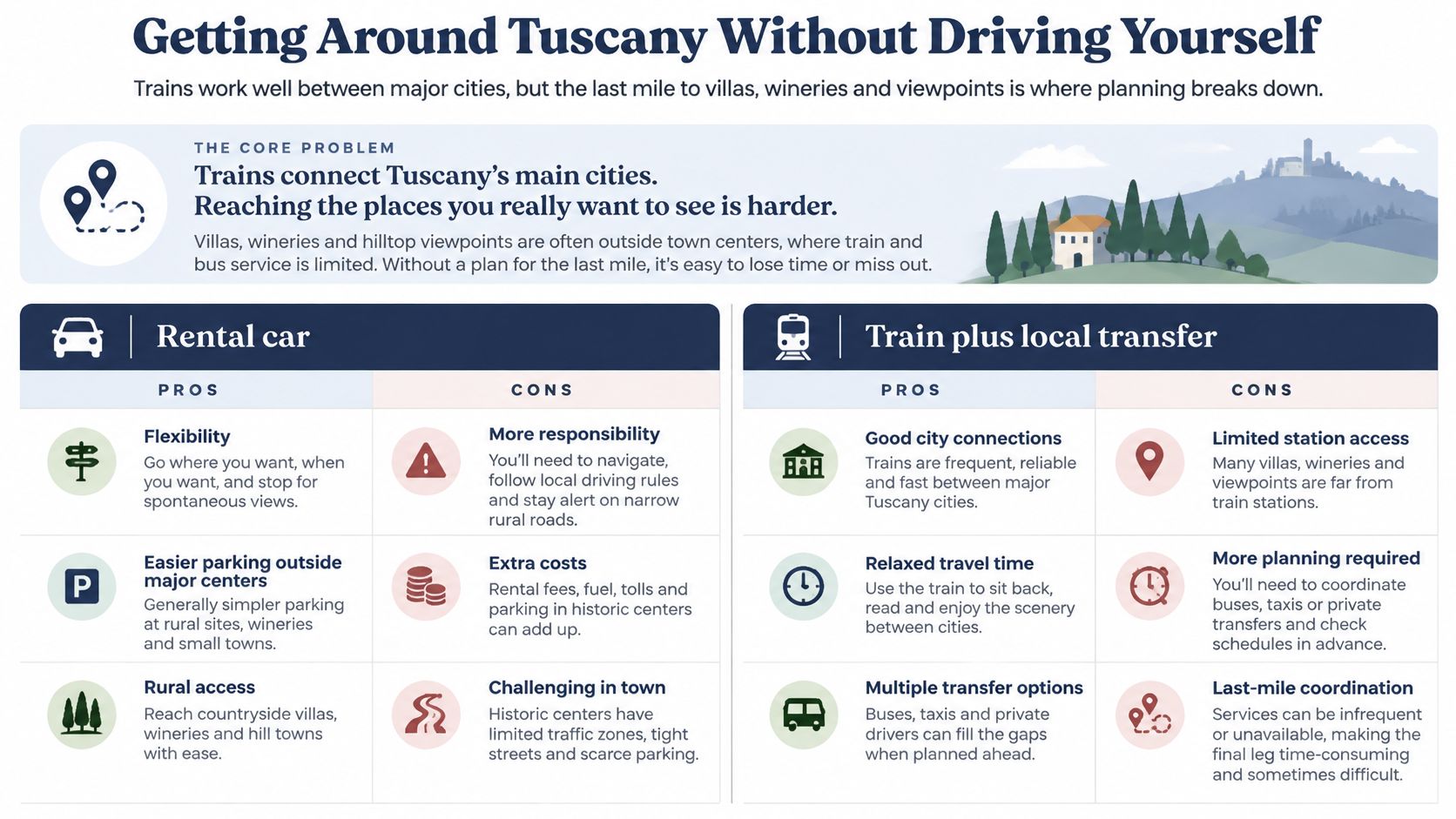
Trains work well between major cities; the difficult part is reaching the individual villa, winery or viewpoint. The Tuscany Regional Survey identifies dispersed rural settlements and difficulties providing transport services, which explains why a nearby station doesn't guarantee convenient countryside access.
Compare the complete journey, including luggage, waiting and the return transfer.
Ground transport options for Tuscany
| Option | Reach | Best for | Main limit |
|---|---|---|---|
| Rental car | Road-accessible villages, wineries and viewpoints | Independent couples with flexible days | Narrow roads, historic-centre access and parking |
| Private driver | Confirmed pickup and drop-off addresses | Families, executives and multigenerational groups | Higher cost; advance coordination |
| Train plus taxi | Major cities and rail corridors, then a local transfer | City-led trips with short countryside hops | Rural taxi availability needs confirmation |
| Regional bus | Towns served by scheduled routes | Budget-conscious town visits | Check evening, weekend and seasonal services |
| Bicycle or e-bike | Lucca's walls and suitable valley routes | Active travelers making short journeys | Hills, heat, luggage and distance |
A rental car gives flexibility, but don't follow navigation instructions straight to a historic-centre hotel without checking its access arrangements. Confirm the permitted approach, unloading point and parking location directly with the property.
A private driver removes the need to drive yourself or nominate a non-drinking guest for winery days. However, child seats, luggage capacity and waiting time must be agreed, not assumed to be included.
Build a transfer contingency plan
Train plus taxi can work beautifully for a city-focused holiday. It becomes fragile when the return journey depends on finding an available car outside a rural restaurant after dinner.
Use this checklist before travel:
- Confirm rural arrivals and departures: Record the exact address, meeting point and contact number.
- Agree winery waiting arrangements: Establish whether the driver stays, returns later or charges separately for extended visits.
- Check family requirements: Specify child-seat needs, mobility aids and luggage before the vehicle is assigned.
- Keep a fallback contact: Save a local taxi number and the property's contact details offline.
- Protect onward connections: Allow for unloading, station access and finding the correct platform.
If your day relies on a chain of unconfirmed local connections, replace that chain with a coordinated driver or a self-drive plan.
The aim isn't to avoid trains. It's to use them where they simplify the holiday rather than where they merely shorten the journey shown on a map.
Villas, Agriturismi and Hotels Compared
Accommodation types by setting and group
| Type | Setting | Best for | Watch for |
|---|---|---|---|
| Villa rental | Private estate with pool, often rural | Families and multigenerational groups | Transport requirements and agreed staff hours |
| Agriturismo | Working farm with rooms or apartments | Quiet countryside and food-led trips | Remote location and limited dinner services |
| Palazzo hotel | Converted noble building in a city centre | Florence or Siena stays | Parking, stairs and older room layouts |
| Boutique hill hotel | Small property near a village | Couples and short breaks | On-site dining and transfer arrangements |
| Estate resort with spa | Estate or hilltop grounds | Longer stays focused on rest | Higher cost and fewer spontaneous town walks |
A villa rental works when shared space is the point of the trip. Before reserving, establish who handles breakfast, groceries, housekeeping and dinner, because private accommodation doesn't automatically mean hotel-style service.
For a multigenerational group, inspect the bedroom plan as closely as the pool photographs. Separate entrances, internal stairs and the distance between bedrooms can matter more than decorative finishes.
Match the property to daily life
An agriturismo suits travelers who want a working-farm setting and a food-led stay. Confirm whether meals require reservations, which evenings dinner is served and whether self-catering facilities are private or shared.
A palazzo hotel is often the better choice when guests want to leave independently for museums, shopping or dinner. Ask about lifts, shower access, connecting rooms and the route from the vehicle drop-off point, particularly if someone has limited mobility.
Boutique hill hotels can offer intimacy without the household organization of a villa. Their weak point is often the evening plan: a lovely terrace isn't a substitute for dependable dining when you don't want another journey.
Check what you'll actually use
An estate resort with a spa suits guests who intend to enjoy the property, not just sleep there between excursions. If every day involves leaving after breakfast and returning after dinner, you may be paying for facilities you won't use.
Before committing, check:
- Village access: Is the route walkable, including after dark, or merely close by road?
- Summer comfort: Confirm air conditioning in the bedrooms you're booking, particularly for July and August.
- Meal arrangements: Establish what's included and which services need advance notice.
- Vehicle access: Check parking, luggage unloading and the suitability of the approach road.
- Transfers: Confirm whether the property can coordinate them and how reservations are handled.
Choose accommodation for the group's daily needs and transport plan, not the photographs. A less secluded hotel can deliver a more relaxing holiday if guests can make their own evening plans.
Build a Seven-Day Route Around Your Bases
For a sample seven-day holiday, I'd limit accommodation changes and give each day a clear purpose. Florence, Greve in Chianti and Montalcino can form a useful progression, provided the exact addresses and transport arrangements work together.
The illustration offers an alternative Florence-and-Lucca pairing. The sample below prioritizes wine country instead.
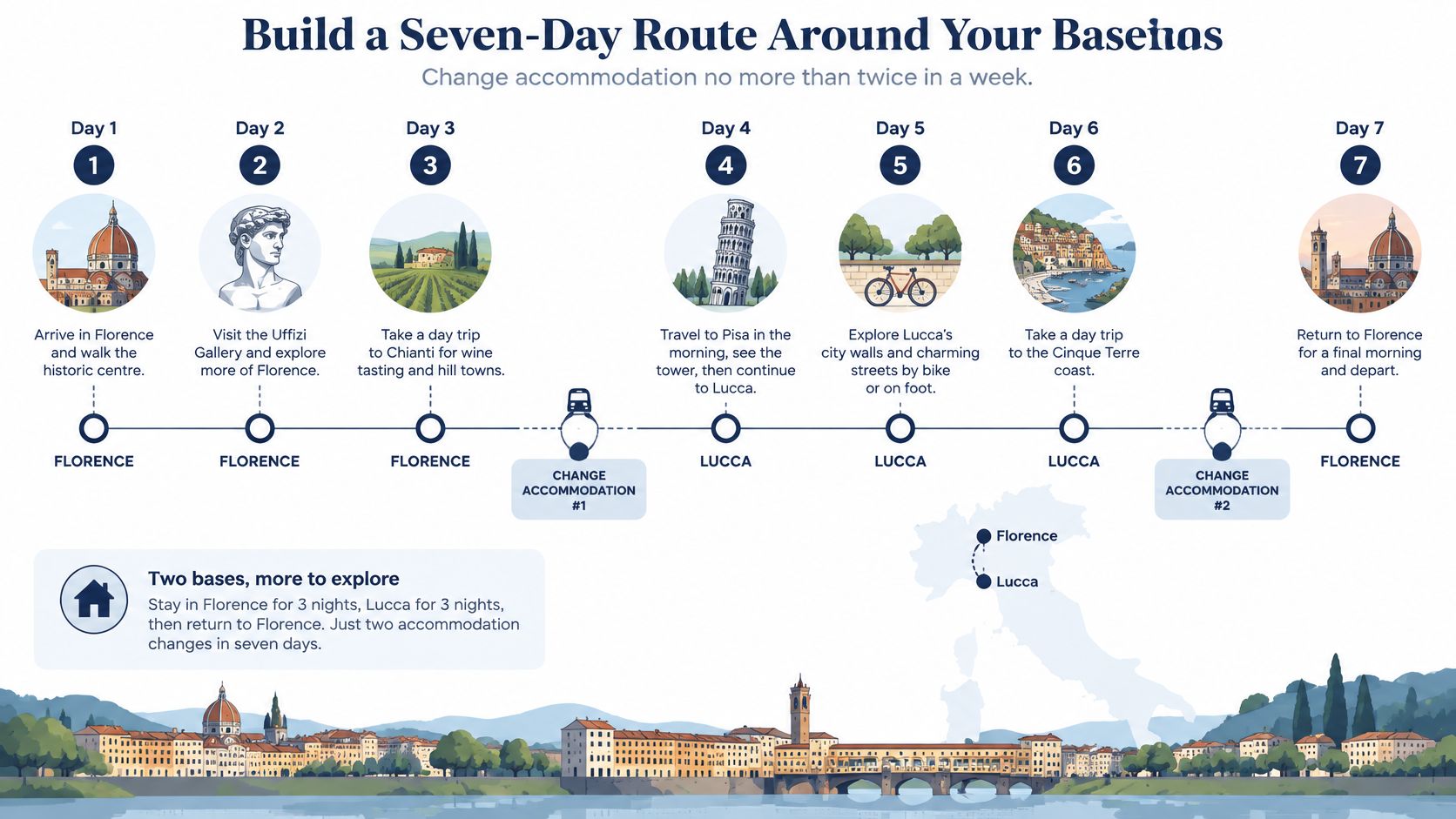
A sample city-to-countryside sequence
Arrive in Florence. Make the historic centre and Duomo area your anchor experience, with no essential timed visit immediately after arrival. Confirm the airport or station transfer against your hotel's actual unloading point.
Visit Siena. Focus on Piazza del Campo and the cathedral rather than adding another town. Use the dated bus timetable or a driver's door-to-door quotation to establish the full return journey before booking entry.
Move to Greve in Chianti. Settle into the property, then visit a nearby wine estate. Have the hotel transfer and winery journey quoted together so lunch, check-in and the appointment don't compete.
Book a private cooking class. Keep the rest of the day deliberately slow, ideally with the class at your accommodation or nearby. This is the buffer afternoon for swimming, reading or an unplanned village stop.
Transfer to Montalcino. Make a Brunello tasting the anchor and treat Val d'Orcia scenery as part of the journey, not an additional checklist. Confirm luggage handling and appointment timing before departure.
Explore Pienza and Montepulciano. Choose a main town visit and make the other stop optional. Obtain a complete loop estimate, including parking and walking access, rather than adding isolated driving estimates.
Return to Florence. For a flight departure, plan backward from the required airport arrival rather than from hotel checkout. If you're staying for a final dinner, keep that evening free of countryside commitments.
Adjust the pace before adding destinations
For a shorter break, choose Florence or a countryside base rather than compressing the entire route. With a longer holiday, extend stays before adding another hotel; Lucca can provide a different pace if cycling and relaxed town life appeal.
Couples combining destinations can apply the same restraint to a Lake Como honeymoon: protect time to enjoy each setting instead of filling every day with movement.
Check Siena's Palio calendar before fixing a summer visit. Spring and autumn can be attractive alternatives, but don't assume that comfortable weather means unrestricted winery availability.
Matching Tuscan Wine Appellations to Your Tastings
Choose the tasting for what you want to learn, not just the reputation of the label. Tuscany's protected appellations provide useful differences in grape composition, maturation and place, but those differences only improve the visit if the estate can explain them well.
The official Tuscan wine guide identifies 58 protected DOP wines and specifies that Brunello di Montalcino uses 100% Sangiovese Grosso, with at least 50 months of total ageing, including 24 months in oak.
Those maturation requirements make Brunello particularly suited to an education-led appointment. Ask what will be poured and whether the visit explains the progression from vineyard to barrel to bottle.
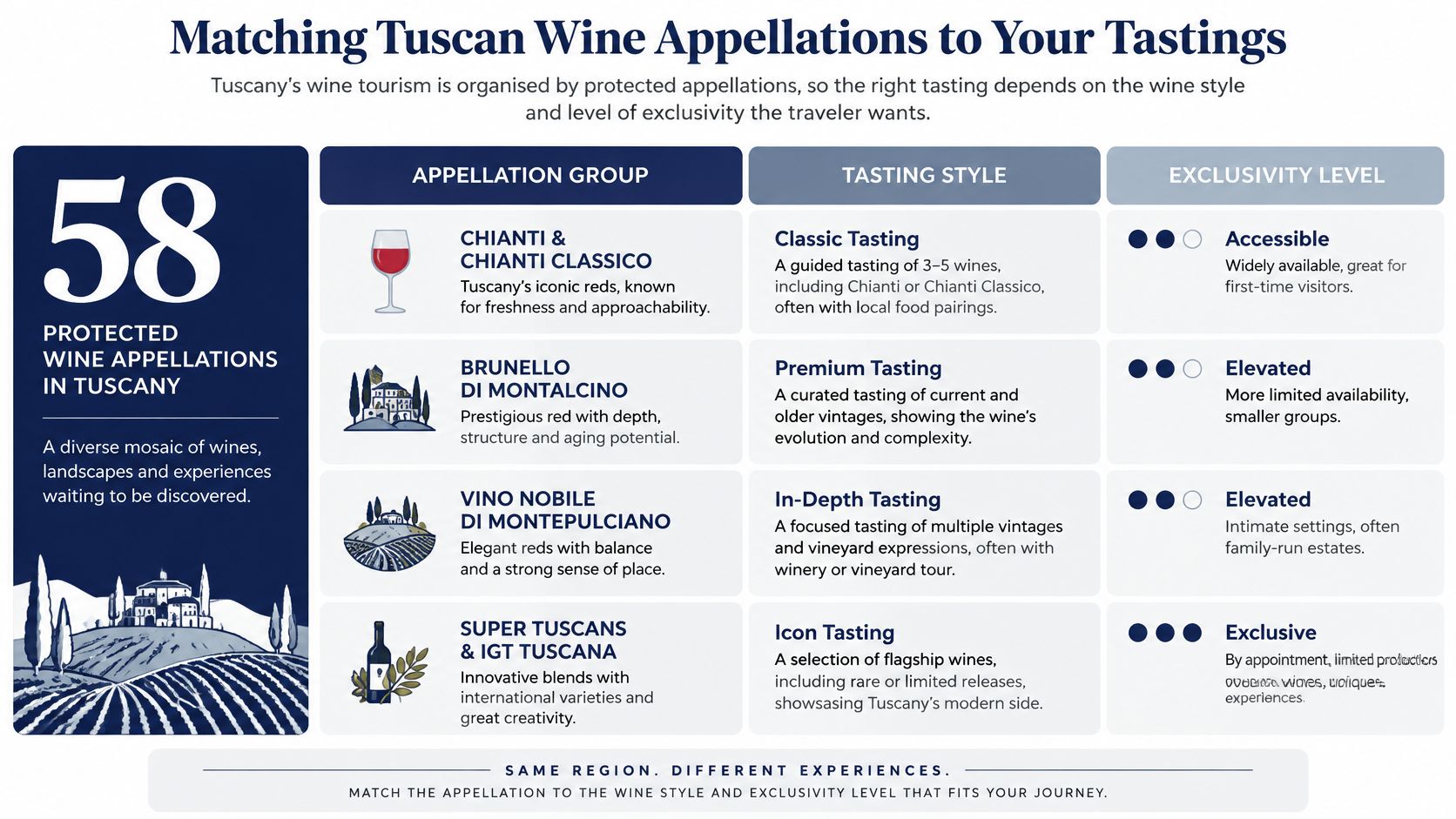
Make Brunello an appointment, not a stop
A worthwhile Montalcino visit should reflect your level of interest. A casual drinker may prefer a welcoming introduction with food; a collector may value a focused discussion of vintages, maturation and the estate's approach.
Ask about current releases, library vintages and appointment format before paying. A private appointment doesn't necessarily include older bottles, a vineyard walk or access to production spaces.
Producer availability should influence the day's schedule. Don't book lunch elsewhere so tightly that the tasting must end just as the discussion becomes interesting.
Use contrast to keep wine days engaging
Vino Nobile di Montepulciano offers a useful comparison with Brunello through its appellation framework and vineyard setting. Plan that visit around a question, such as how site and blending choices affect the finished wine, rather than asking for another broad introduction to Tuscany.
Chianti Classico is a sensible local focus when you're based around Greve. Keeping that appointment close to your accommodation leaves more room for a proper lunch or village walk.
For each estate, establish:
- Tasting content: Which wines, vintages and food pairings are included?
- Visit format: Is it a hosted tasting, cellar tour, vineyard visit or a combination?
- Guest suitability: What can non-drinkers and younger family members do?
- Purchase arrangements: Can the estate explain delivery options before you buy?
A better wine itinerary gives you a reason to remember each estate, not simply another glass to compare.
Ask the host to sequence pours from lighter to more powerful styles where appropriate. Leave a non-wine day between intensive visits, and stop adding estates when the schedule no longer allows time to ask questions.
Book the Key Experiences in the Right Order
Book the least replaceable experience first. If a particular Brunello producer is the reason for your trip, establish its appointment availability before committing to the surrounding countryside schedule. If a museum visit matters more, secure that entry and arrange the other activities around it.
Avoid treating generic advance-booking windows as guarantees. A private chef's calendar, a producer's appointment system and a seasonal truffle outing require different checks, so the useful deadline is the one attached to your chosen host and date.
Tuscany experiences and booking lead times
| Experience | Where | Book how far ahead | Why it matters |
|---|---|---|---|
| Private cooking class with a local chef | Florence, Siena or a farmhouse | Request availability once your base and preferred day are settled | Menu, venue and group requirements need coordination |
| Guided Brunello tasting | Montalcino | Prioritize when a particular producer is essential | Estate appointment capacity determines the schedule |
| Medici villa and garden visit | Florence area | Check the chosen property's calendar before fixing the day | Opening arrangements differ between properties |
| Truffle hunt with a guide | Rural Tuscany | Confirm the relevant season and guide availability first | The outing must suit local conditions and access |
| Val d'Orcia landscape day | Pienza and Montalcino | Reserve the driver once the route is agreed | Stops, vehicle requirements and pickup address need alignment |
| Uffizi timed entry | Florence | Check official availability as soon as dates are fixed | Your entry time shapes the rest of the day |
Choose experiences that add something different
A Medici villa visit offers a valuable counterpoint to city museums, connecting architecture, gardens and countryside. The regional tourism authority's UNESCO guide identifies 12 Medici villas and two Medici gardens and records the recognition of Italian truffle hunting and extraction as intangible cultural heritage in 2021.
Choose the specific villa before arranging transport. Don't assume that every property offers the same access, garden experience or visitor facilities, and distinguish a guided exterior visit from admission to interiors.
For a truffle outing, clarify the terrain, footwear, weather arrangements and whether a meal is included. The appeal is the guided search and explanation of the surroundings, not a guaranteed haul.
Reserve the anchors and protect the gaps
A private cooking class is especially useful for groups with mixed interests because everyone can participate without needing prior knowledge. Agree the menu, dietary requirements, children's involvement and whether the session ends with a shared meal.
Little Blue Door has arranged guided wine tasting and a private cooking class with a local chef in Tuscany, where clients learned to make authentic Tuscan dishes. That combination can provide contrasting anchors without making every day dependent on an appointment.
Leave room for wandering in San Gimignano or Pienza, but make those open periods stay open. A free afternoon followed by a distant, non-refundable dinner reservation still creates a deadline.
Before confirming the trip:
- Settle the base: Choose where you want to return each evening.
- Validate the route: Obtain realistic door-to-door estimates and remove unnecessary backtracking.
- Match the accommodation: Check room layouts, meals and access against the group's needs.
- Secure the anchors: Confirm the exact experience, inclusions and cancellation terms.
- Complete the transport plan: Reserve rural arrivals and departures, then document pickup instructions.
Keep the confirmations together in a shared itinerary that includes addresses, local contacts and meeting points. A polished schedule is useful only if everyone can act on it when a train is delayed or an appointment changes.
Little Blue Door's in-house advisors create each itinerary à la carte, combining accommodation, private transfers, curated activities and restaurant reservations, with dedicated team support throughout. Visit Little Blue Door and send your dates, group size, preferred base and chosen experiences to request a draft Tuscan route that checks transfer arrangements and booking availability before you commit.