Private Yacht Charters Greece: Seasons, Costs and Routes
Private Yacht Charters Greece guide: choose the right season, route and crew, check legal requirements and budget realistically before you book.
Six people, one group chat, and a decision that keeps circling back to the start. Everyone likes the idea of a week on the water in Greece. Nobody agrees on what the boat should be. One wants to sail and feel the hull lean. One wants a chef, shade and a captain who knows which bay is empty at six in the evening. A third gets queasy on a forty-minute ferry and hasn't mentioned it yet.
That gap between the idea and the booking is where most Greek charters go wrong. Rarely because the islands are hard to reach or the yachts scarce, but because the group picks a route before it picks a charter type, a month and a legal structure.
There's a working order to this. Charter type first, then the months the wind allows, then the region that matches the people travelling, then the cost and the paperwork around it. Get the sequence wrong and you'll spend the budget on a boat that fights the weather.
What a Private Yacht Charter in Greece Includes
Every Greek charter runs on one of four setups, and the setup comes down to a single question: who is responsible for the boat. Answer that and the crew, the route planning and most of the budget fall into place around it.
| Charter type | Crew on board | Who navigates | Best for |
|---|---|---|---|
| Bareboat | None | Guests, with a valid skipper qualification | Confident sailors who want full control |
| Skippered | Skipper | Skipper, guests help on deck | Families and groups who want to sail without handling navigation |
| Crewed luxury yacht | Captain, chef and deckhands | Professional crew | Celebrations, executives and privacy-first trips |
| Gulet | Captain and crew | Professional crew | Groups who want a traditional wooden-boat cruise |
The gap between the first row and the third is bigger than it looks. On a bareboat, the guests untie the lines, read the forecast and decide where dinner happens. On a crewed yacht, the captain has already checked the forecast twice and the chef is asking about allergies before anyone steps aboard. Same coastline, two different holidays.
Fleet depth is not the constraint. Greece had 3,030 vessels available for charter in 2025, including 904 catamarans, according to Riginos Yachts' annual market analysis. That catamaran count matters for families and multigenerational groups: two hulls give a level saloon, a wide foredeck for shade sails and toys, and cabins at opposite ends of the boat for the people who want to sleep while the others keep talking. At the top of the market, reporting on the Greek charter fleet in 2023 counted around 400 large charter yachts operating in Greece, with vessels reaching up to 95 metres.
A bareboat works like a rental car: you hold the keys, you carry the responsibility, and the freedom is the point. A crewed yacht is the car with a driver who knows the roads, handles the parking and tells you which village is worth a stop.
What the crew covers and what it doesn't
A captain carries the licence, the local knowledge and the final call on weather. A chef plans provisioning, shops with the group's dietary notes and cooks around the anchorages rather than a fixed menu. Deckhands run the tender, handle mooring lines and keep the water toys working.
That last job earns its keep around day three, when the tender outboard refuses to start and nobody aboard has touched a fuel line since the safety briefing.
What usually sits outside the headline fee: fuel, marina and port charges, provisioning and drinks, crew gratuity, and ground transfers. None of that is a surprise if it's named in writing at the quote stage.
Ask early: what does the fee include, and what will I be billed for at the end? A quote that can't answer both in writing isn't a quote yet.
Three questions settle the charter type faster than any brochure. How many people are sleeping aboard, and are any of them children or older guests who need a stable boat? Is there a qualified sailor in the group, or does the boat need its own skipper? And how much service does the group want, from cooking and mooring yourselves to not lifting a finger? If the budget forces a trade-off, I'd put the money into crew before size: a good captain changes the week more than an extra cabin does.
Choosing the Best Months and Wind Windows
In Greece the month and the wind decide the itinerary far more than the island list does. A route that works beautifully in June can be a miserable, expensive slog in the third week of July, and the difference has a name: the Meltemi.
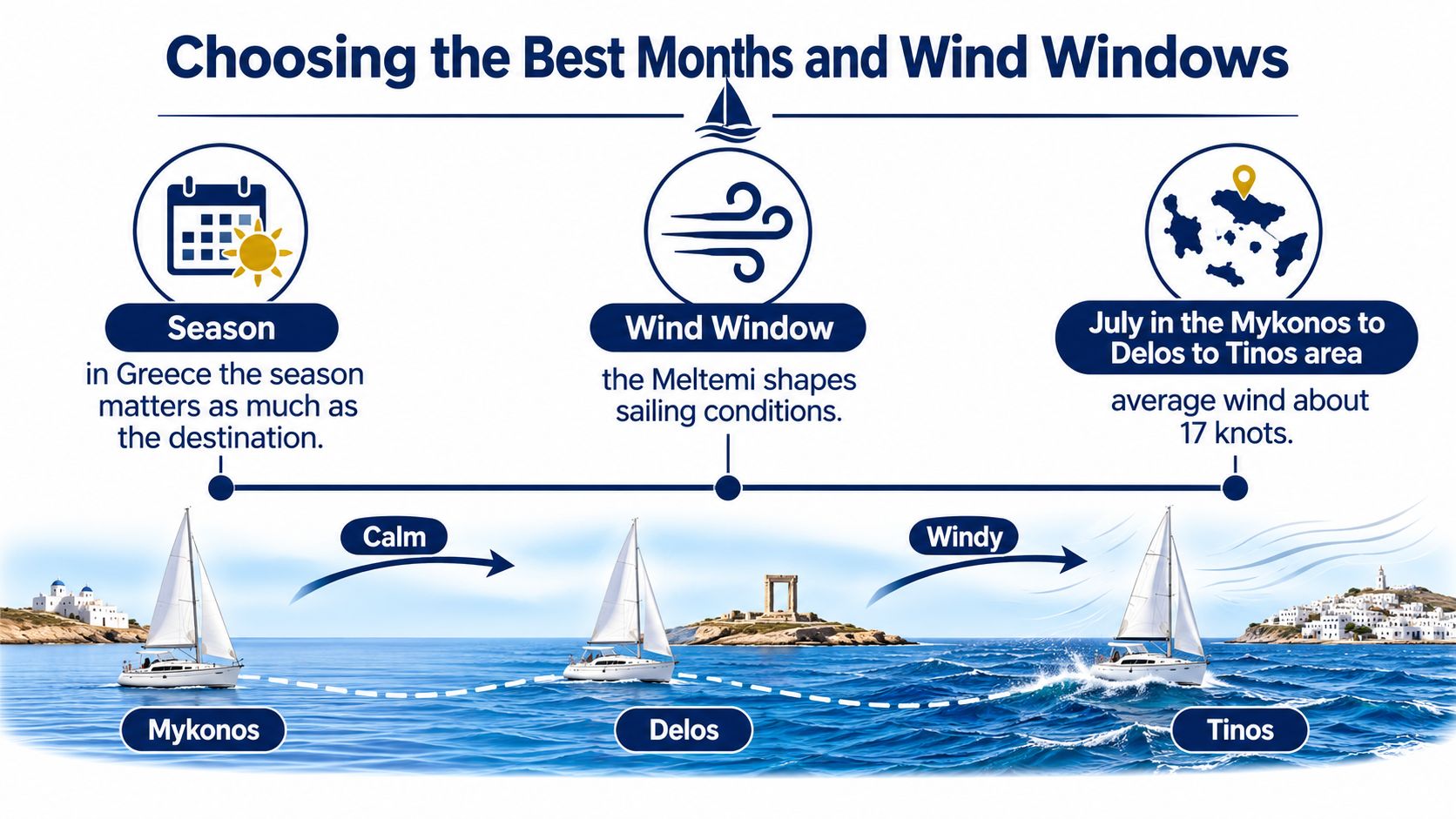
A ten-summer dataset for 2016 to 2025 puts numbers on the pattern. In the Mykonos, Delos and Tinos area, July afternoons average about 17 knots, with winds reaching 22 knots on roughly 34% of July days. August averages about 17.4 knots, with 22-knot conditions on around 32% of days, as the Meltemi wind analysis sets out. Those aren't gale figures, but on a charter they're the difference between a comfortable lunch stop and a table of guests holding their glasses.
| Period | Typical wind | Best-fit routes | Planning note |
|---|---|---|---|
| May to June | Lighter, variable winds | Cyclades and Ionian | Quieter marinas, cooler sea |
| July to August | Meltemi, about 17 knots in the afternoon | Saronic Gulf, or morning passages in the Cyclades | Peak demand and strong afternoon wind |
| September | Winds ease, sea stays warm | All regions | Strong shoulder season |
| October | Lighter but changeable | Ionian and Saronic, with short hops | Confirm conditions with the operator before booking |
The daily pattern matters more than the monthly average
The wind builds from late morning into the afternoon. That single fact should shape the schedule. Exposed north-south passages and channel crossings belong in the morning, before the build. After lunch, the sensible plan is a protected anchorage, a swim, a long lunch ashore, and a short hop late in the day if the group still has energy.
Do the opposite and you pay for it three ways: steeper seas on the nose, higher fuel burn on a motor yacht pushing into it, and guests who decide the boat isn't for them.
Practical rule: schedule the long crossings before 11am and treat the afternoon as anchorage time. The itinerary that ignores this looks fine on paper and feels rough in practice.
The Saronic Gulf is the technical fallback. The same dataset records July afternoons of about 7.6 to 8.0 knots around Hydra and the Saronic, with no 22-knot days recorded in that comparison. For families, older guests, celebration groups and anyone who values swimming over mileage, that's a materially easier week.
May, June and September usually bring lighter winds and thinner crowds, and the sea is warm enough by June for a full day in the water. By October the pattern loosens and the seasonal businesses along the route start closing, so confirm conditions and opening hours with the operating company before you commit.
Matching Islands and Marinas to Your Group
The physical geography explains why Greek island-hopping works at all. A Greek government coastal and maritime tourism report describes thousands of islands and islets, more than 16,000 kilometres of coastline, and 22 organised marinas serving motorboats, sailing yachts and catamarans with a combined 8,924 berthing places. Count marinas, tourist ports and tourist-vessel shelters together and the figure rises to roughly 23,500 berths, according to the coastal and maritime tourism report.
That network is why a charter can start in Athens and still spend a week in the Cyclades, the Ionian, the Dodecanese or the northern Aegean without treating one port as home.
It also sets the planning constraint. Berths cluster in specific ports, and demand is heavily seasonal. A long coastline doesn't mean a free mooring in the harbour you had in mind on a Saturday in August. Routing and advance booking are what make the difference between a relaxed week and a nightly scramble.
Market data from the 2025 season points the same way from the demand side. Greece took 25% of GlobeSailor departures, the largest share of any destination, and the Saronic Islands were identified as less crowded than the Cyclades and the Ionian, per the 2025 yacht charter barometer.
So match the region to the people, not to the photographs.
A family with young children. The Saronic Gulf gives shorter hops, calmer water and an easy arrival from Athens airport. Hydra, Spetses and Poros are close enough that a bad day costs you an hour, not a week. The trade-off is scenery: the Saronic is charming and historic rather than dramatic, and it doesn't deliver the white-and-blue cliffside postcard.
A celebration group. The Cyclades deliver the scenery that justifies the trip, and a sheltered bay with a good taverna saves the afternoon when the wind builds. The trade-off is exposure on crossings, which is why the route needs morning passages and a named backup anchorage for every leg.
A couple who want privacy. Fewer marina nights, more anchoring, and a route that skips the busiest harbours will beat the famous circuit every time, which matters if the trip is a tenth-anniversary escape where quiet water counts for more than a harbour photo. The trade-off is logistics: anchoring out means the tender does the work, and provisioning has to be planned rather than improvised.
The most famous route in Greece is a marketing decision. The right route is an operational one.
What a Charter Costs and Why Prices Vary
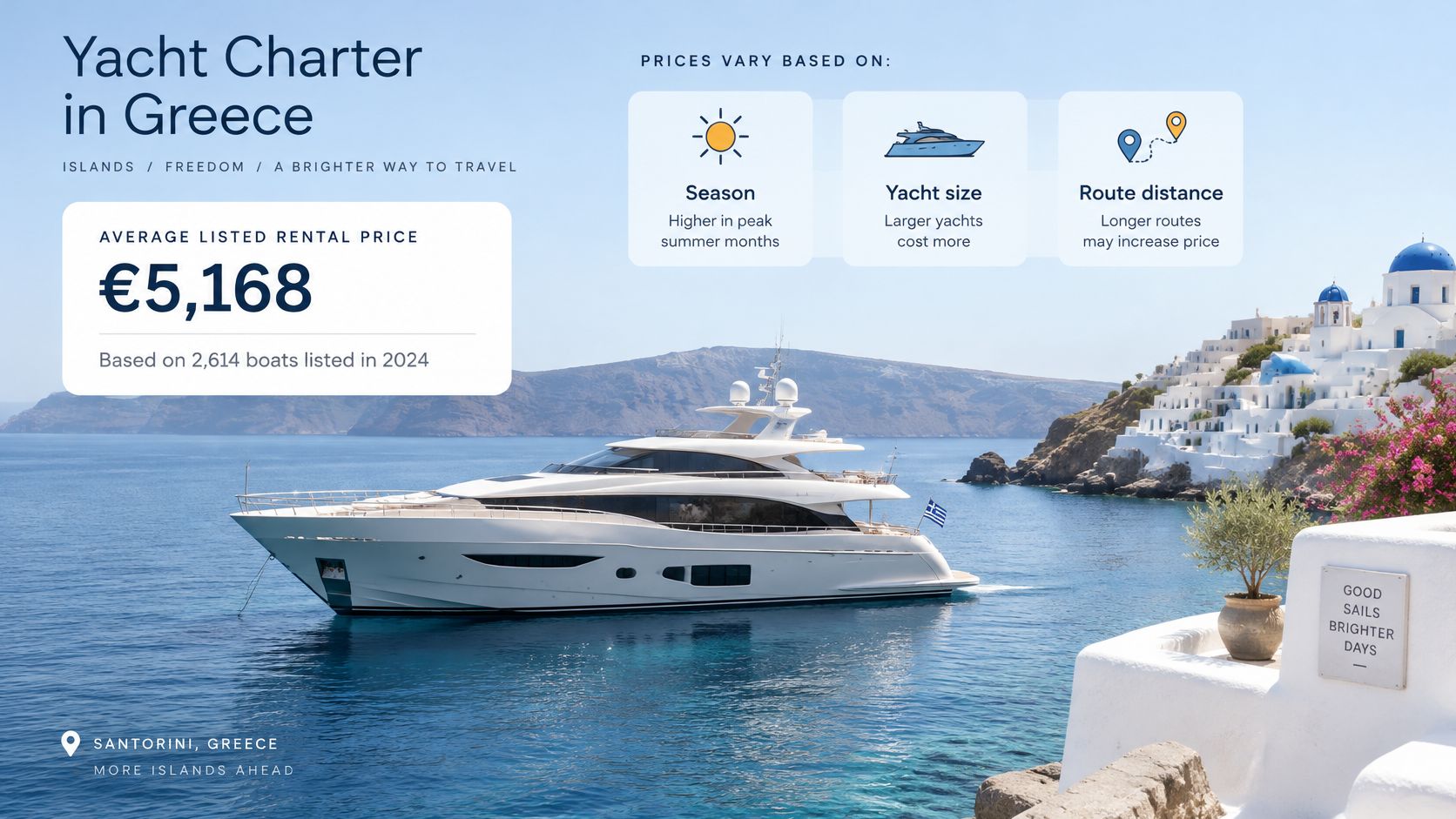
Start with a reference point rather than a range. Greece had 2,614 boats listed in 2024, with an average listed rental price of €5,168, according to Yacht-Rent's Greece charter statistics archive.
That average is a starting reference, not a budget. A listed average blends small sailing yachts, large catamarans and crewed motor yachts across different seasons, so it tells you where the market sits rather than what your trip will cost.
| Cost item | What moves the price | Confirm in the quote |
|---|---|---|
| Charter fee | Boat size, season, crew level | Whether crew and insurance are included |
| Fuel | Route length, sea state, motor use | Whether fuel is billed at cost or fixed |
| Marina and port fees | Berth choice and number of stops | Which ports are included |
| Provisioning and drinks | Group size and dietary needs | Who shops and who pays |
| Crew gratuity | Service level and trip length | Whether it is included or expected |
| Transfers | Airport or port distance | Whether private transfers are included |
Where the money actually goes
The charter fee is the visible number and rarely the whole bill. Fuel swings with how much the captain motors into weather, which is another reason the wind window from earlier belongs in the cost conversation.
Marina and port fees depend on whether you're in a municipal quay or a serviced marina, and on how many stops you make. Provisioning moves with group size, dietary requirements and how often the group eats ashore. Gratuity is expected on crewed and skippered trips and should be established as included or additional before the deposit, not at the end of the week.
Transfers get forgotten because they're not the boat. Two airport runs for eight people with luggage are a real line item, and a remote embarkation point costs more than a city marina.
Compare quotes on the same basis. A lower fee with fuel, gratuity and port fees excluded is often the more expensive booking.
A worked example makes the point. Say eight guests want the same crewed yacht in August rather than June. The fee for peak weeks sits higher because demand does, the berth reservations are harder to secure, and the extras measured as a share of the total can drift well above what the group expected. Two quotes for that same week are only comparable if both itemise fuel, ports, provisioning, gratuity and transfers.
Ask for an itemised quote in writing, with inclusions and exclusions on one page. If you're still mapping the wider market, this guide to arranging a luxury yacht charter covers how the booking process runs from enquiry to embarkation.
Legal and Crew Checks Before You Sign
Greece checks compliance at two levels: the vessel itself and the company operating it. That split matters most when the yacht is foreign-flagged or the provider is established in another EU state, because the paperwork route changes with the flag.
Greece runs an e-CharterPermission process for chartering certain professional pleasure boats recognised under another country's law, while EU-based providers operating temporarily and occasionally in Greece fall under a separate cross-border services procedure, as the Greek government's e-CharterPermission guidance sets out.
Work through five checks before the deposit moves.
- Ask for evidence of the yacht's professional or commercial status. This is the document that shows the boat may legally be sold as a charter, and it's the first thing a broker should be able to produce without a delay.
- Confirm which permission or notification route applies. Foreign-flagged and EU-based operators don't use the same procedure, so the correct route should be named in writing rather than assumed.
- Check the contract structure. The charter period and the way each charterer is named should line up with the permission route confirmed in check 2. Where more than one party signs, make sure the contract reflects that arrangement rather than defaulting to a single charterer.
- Reconcile the guest list with the passenger-bed capacity. Passenger numbers can't exceed the vessel's legal sleeping capacity, so the manifest and the boat should agree before anyone pays.
- Match the embarkation and disembarkation points to the contract. The ports in the contract and the ports in the operational plan should be the same ports.
The risk you're actually managing
An itinerary can be marketed as a private charter while the vessel's status, the contract or the passenger configuration doesn't satisfy Greek operating rules. The failure surfaces at the dock, when the group is standing there with luggage, not during the sales conversation when there's still time to walk away.
Keep the permission documents, the contract and the guest manifest with the rest of the booking file. If a question arises at embarkation, a saved PDF answers it faster than a phone call.
None of this is adversarial. Good operators expect the questions and answer them quickly. A provider who goes quiet when you ask for commercial status is telling you something useful.
Plan and Book Your Charter Step by Step
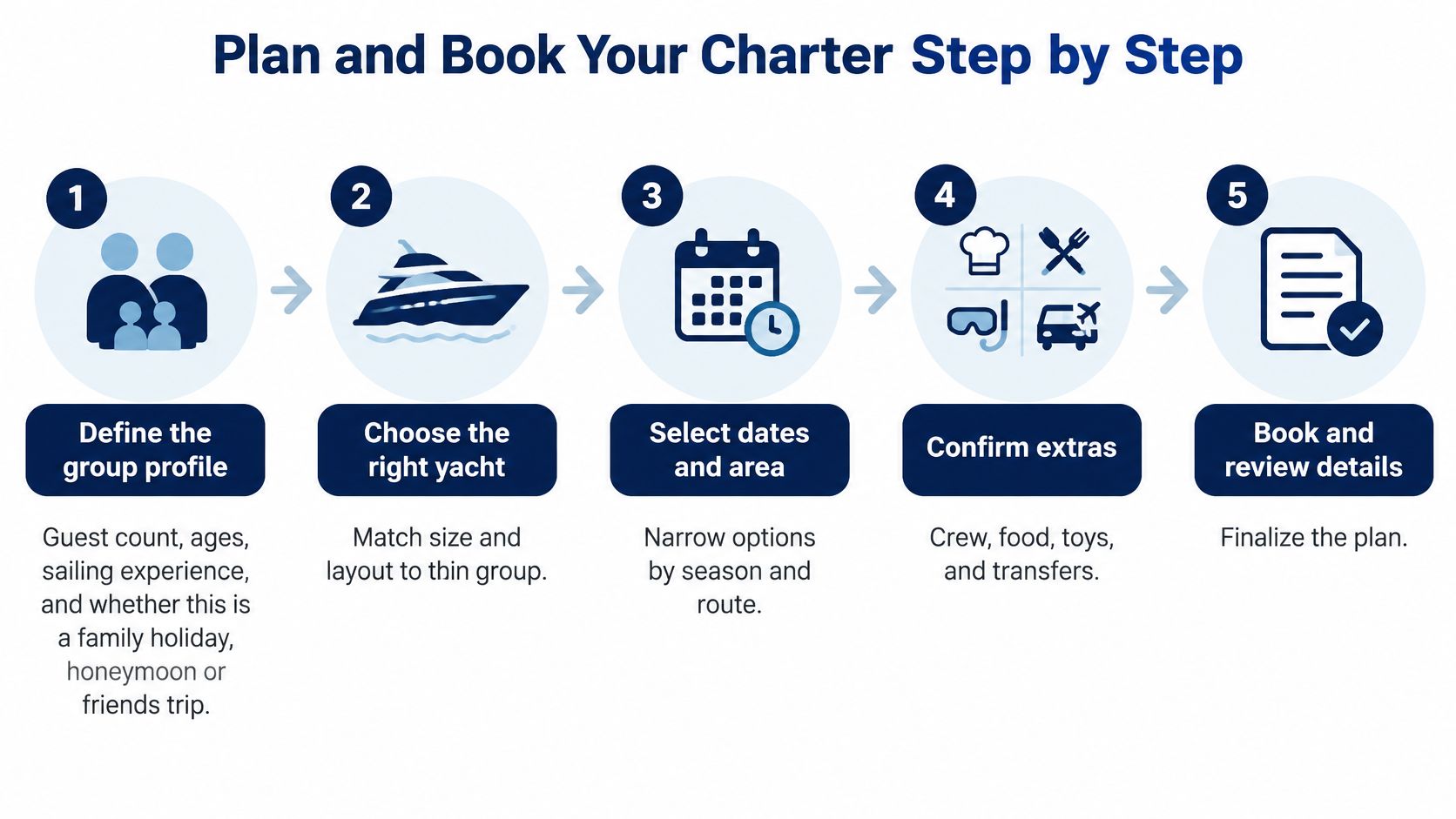
Each choice narrows the next one, so the order below is the order that works. Book the boat before checking the season and the group can end up with a yacht too big for the harbour it wanted, in a month the wind makes miserable.
Define the group profile before anything else. Guest count, ages, sailing experience and the purpose of the trip: family holiday, honeymoon, milestone birthday or executive retreat. Plan for the people aboard, not for the fleet. A group with two non-swimmers and a toddler is a different brief from six thirty-somethings who want to dive every morning, and it changes the yacht, the crew and the region.
Pick the season and check the wind window. If the dates land in July or August, build the itinerary around morning passages. This is the decision most often made too casually, usually because someone has already fallen for a specific island.
Choose the region to match the group's priorities. The Saronic for calm water and young children, the Cyclades for scenery with a sheltered fallback, the Ionian for shorter passages. Check airport transfers before copying a famous island sequence out of a magazine.
Select the charter type and confirm the crew it includes. Bareboat means a qualified skipper inside your group plus a security deposit. Skippered and crewed options change the cost structure but remove the operational risk. Be honest about which version the group will enjoy.
Build the route with a weather alternative for every crossing. Name the backup bay or harbour in advance, not at the moment the captain makes the call. A route with no alternatives is a schedule, and schedules break in the Aegean.
Reserve berths and embarkation points early. Summer berth supply tightens around the popular ports, and the good ones go first. An embarkation marina that suits the group's flight arrival is worth more than one that looks better on a map.
Shortlist two or three operators and compare them on the same basis. Ask for crew backgrounds, permission documents and itemised quotes covering identical inclusions, then weigh captain experience and crew continuity alongside price. A good crew is what the group remembers.
Hold dates with a backup window and get the cancellation terms in writing. Flights, yachts or special events may be 100% non-refundable regardless of the notice period given, so a written cancellation schedule matters more than a verbal reassurance. If the group can shift by a week, say so at the enquiry stage.
Finish provisioning, dietary needs and shore plans three to four weeks before departure. Confirm allergies and preferences with the chef, book the one restaurant that matters, and settle transfers at both ends. If the group is weighing a week at sea against a land alternative, this guide to Italian vacations in Tuscany shows how a comparable itinerary comes together.
The most common slip sits between steps four and five: groups lock a yacht, then try to force a fixed island list onto it instead of letting wind and berth availability shape the route around the boat.
One next step: write down the guest count, the months that work and a realistic budget range. Those three lines are what any good operator needs to come back with something worth reading.
Running nine steps across three operators is a job in itself. Little Blue Door builds private yacht charters in Greece as part of a wider trip, pairing the boat with villas, private transfers, restaurant reservations and the ground arrangements around it. Every itinerary is created à la carte by in-house advisors, and the supplier network covers yacht charters, private aviation, villas, chauffeurs and experience providers worldwide, so the crew level, the region and the pace are set by your group rather than a fixed package. Start by sharing those same three lines with Little Blue Door, along with what the week should feel like.