Luxury Yacht Charter in Aruba: Costs and Planning
Plan a luxury yacht charter in Aruba: compare formats, budget beyond the base rate, match the yacht to your group and avoid non-refundable surprises.
A charter page quotes a weekly rate and calls it the price. It isn't. On a crewed yacht, the advertised fee buys the boat, the captain and the crew's time, and most of what makes the week comfortable arrives later as a second invoice: fuel, food and drink, berthing, and the tip.
That gap is the reason two groups can book the same vessel in the same month and end up with wildly different totals. One runs the yacht hard between stops and eats aboard every night. The other anchors early, swims off the transom and dines ashore. Identical boat, different bill.
Aruba sharpens the effect, because the island's shape and wind pattern push every itinerary into a short, repeating loop with constant tender runs. Settle the format and the cost structure before you look at hulls, and the rest of the planning falls into place.
Pick the Charter Format That Fits Your Day
A charter in Aruba is a private booking: one group, one captain and crew, no shared seats and no departure queue of strangers. That definition matters more than any brochure photograph, because it's what lets you choose the loop instead of accepting a schedule.
Aruba runs roughly 32 km from tip to tip, and that geography does most of the itinerary work. A half-day or full-day loop reaches the beaches and snorkel sites on the sheltered side without long repositioning, and the same loop reverses when the sea builds. Overnight and multi-day trips are a different proposition, because anchorage permissions and marina space start deciding the route instead of the map.
| Format | Typical length | Best for | Planning note |
|---|---|---|---|
| Half-day cruise | About 4 hours | Beach stops, swimming and snorkeling | Fits one afternoon; limited time for distant sites |
| Full-day charter | About 8 hours | Families and groups wanting several stops and lunch on board | Allows a calm-side loop plus a longer swim stop |
| Overnight or multi-day | Two or more days | Celebrations, corporate stays and sleeping aboard | Anchorage rules and marina space decide the route |
Three questions settle the format before you compare a single yacht.
- How many hours do you want on the water? Four hours suits a beach stop, a snorkel and lunch. Eight hours buys a second bay and a slower pace. Anything longer means the boat becomes the accommodation.
- How many stops? Every stop costs tender time and crew attention. Groups who want five stops in an afternoon usually enjoy two of them and spend the rest watching the tender run.
- Does anyone want to sleep aboard? This is the question that changes the booking category, because it pulls in anchorage rules, marina berths and full provisioning.
The format also sets the cost pattern. Multi-day trips carry the complete provisioning and crew load, while a half-day is priced as a day rate with the same percentage logic layered on top. Peak winter months, roughly December to April, tighten availability across the island, so the format decision is worth making early rather than shopping for the boat first. Charter demand supports that urgency: The Business Research Company recorded the global luxury yacht charter market growing from USD 15.33 billion in 2023 to USD 16.27 billion in 2024, a 6.1% increase.
If the charter is one part of a shorter break, set the dates in our guide to a quick weekend getaway before you commit to a vessel.
Write it down: one line, one format. Every cost, crew and routing question downstream depends on that line.
Real Costs Beyond the Base Rate
The advertised rate buys the boat. Everything that makes the trip happen sits in two further layers, and neither appears in the headline price.
Charter guidance from Allied Marine puts the Advance Provisioning Allowance (APA) at about 25% to 35% of the base fee. The APA is a working fund rather than a fee: it covers fuel, food and drink, port and mooring charges, communications and other itinerary-dependent costs, and the unused balance is normally reconciled after the voyage. On top sits the crew gratuity, customary at 10% to 20% of the base fee.
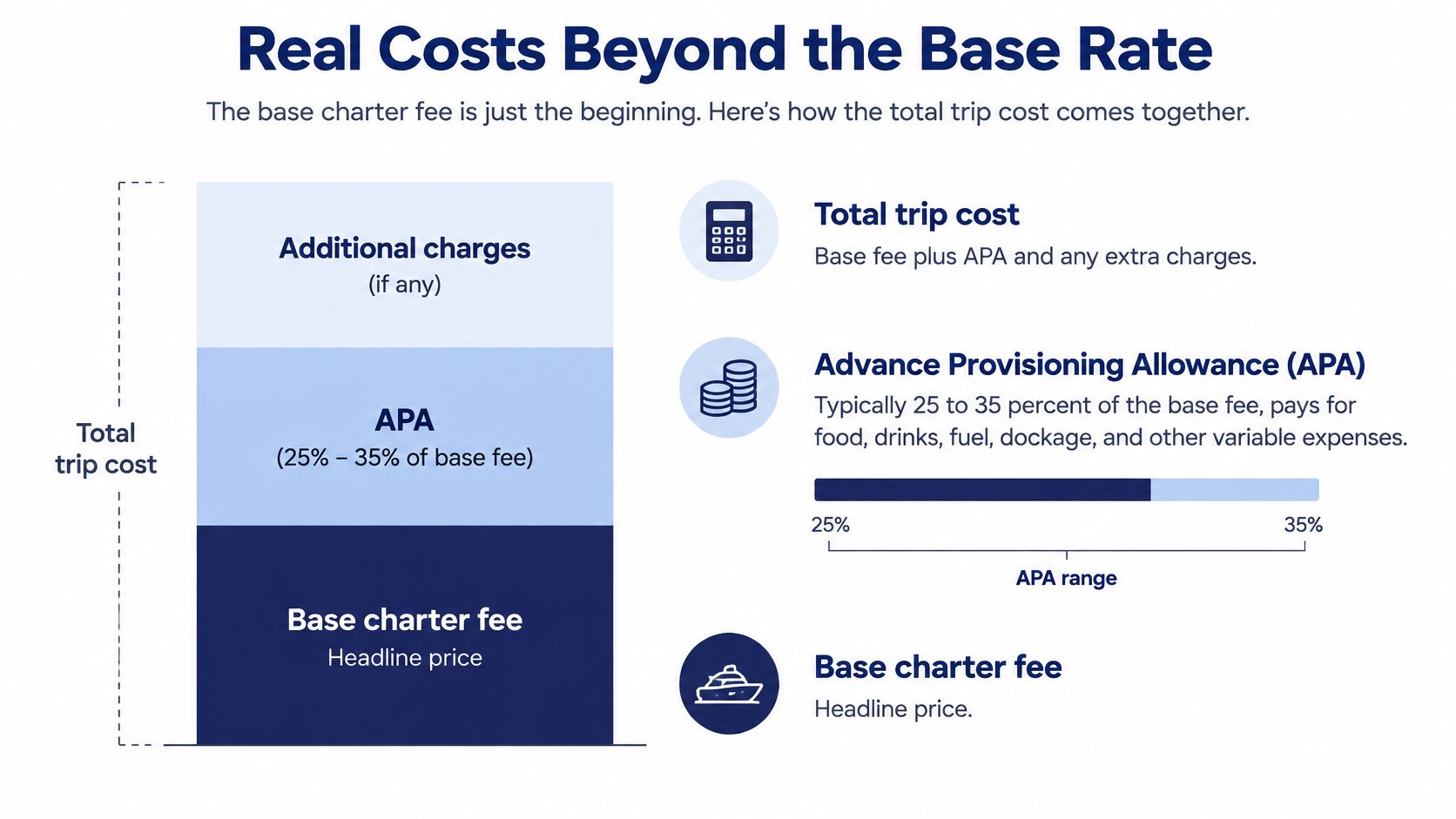
Work it through on a USD 100,000 weekly base, which is the example the same guidance uses. APA at 25% to 35% lifts the working budget to roughly USD 125,000 to 135,000 before tax and gratuity. Add the customary gratuity and the estimate lands between USD 135,000 and 155,000 before tax: a 10% gratuity produces USD 135,000 to 145,000, while a 20% gratuity pushes the top case to USD 145,000 to 155,000.
| Cost layer | Typical share | Amount on USD 100,000 base | What it covers |
|---|---|---|---|
| Base charter fee | 100% | USD 100,000 | Advertised weekly rate |
| Advance Provisioning Allowance | 25–35% | USD 25,000–35,000 | Fuel, food and drink, port and mooring, communications; unused balance reconciled after the trip |
| Subtotal before tax and gratuity | Sum of rows above | USD 125,000–135,000 | Working budget for operating costs |
| Crew gratuity | 10–20% | USD 10,000–20,000 | Customary, paid on top of the base fee |
| Estimated total before tax | Sum of rows above | USD 145,000–155,000 | Upper estimate with gratuity at 20% |
Where Aruba pushes the numbers
Three things drive an Aruba APA toward the top of its range rather than the middle. Longer runs between beaches burn more fuel than a single bay would. Constant tender use for swim stops and water toys adds engine hours and crew time. And provisioning for a large group, especially one eating aboard most nights, costs more than the same headcount eating ashore twice a day.
A high-speed motor yacht on a multi-port itinerary with heavy tender use raises fuel consumption and marina exposure, and remote or awkward provisioning points raise logistics costs. The reverse is equally true: anchor once, swim off the boat, eat ashore, and the same APA stretches. The percentage band stays fixed, but where you land inside it is almost entirely a routing and provisioning decision, which is why two identical base rates can finish a week thousands of dollars apart.
What to ask for in writing
- An itemized quote, listing the base fee, the APA estimate, the gratuity rule and the taxes as separate lines.
- The reconciliation timing, meaning when the unused APA comes back and in what form.
- The tax basis, because taxes and local fees may be calculated on the base fee or on the APA, and the difference is not trivial.
For half-day and full-day charters, ask for the day rate and apply the same percentages to it. The percentages don't change with the length of the trip, only the base they're applied to.
Practical rule: compare quotes on the total, never the headline. A yacht advertising a lower weekly rate with a heavier fuel and crew profile can cost more than the one that looks expensive on the page.
Matching the Yacht to Your Group and Plans
Yacht selection is an operational decision before it's an accommodation one. The hull that photographs best can be the wrong boat for eight guests who want four swim stops and dinner aboard.
Running costs explain the rate structure. Annual operating costs are commonly estimated at about 10% to 20% of a yacht's purchase value, driven by size, age, crew complement, fuel use, berthing, technical complexity, charter activity and refit requirements, according to The Luxury Playbook's comparison of chartering and owning. That benchmark is why a commercially managed yacht prices its charter weeks to recover hospitality costs plus a substantial fixed technical overhead.
Fuel and crew costs also climb nonlinearly with ambition. More volume means more crew and more hotel-system capacity, and fast or long-distance cruising adds engine hours and fuel exposure. A bigger, better-crewed yacht can therefore carry a higher base rate and still reduce operational friction, while a smaller boat is often the more efficient choice for a short, stop-heavy day.
The one-page brief
Write these seven lines and hand the same page to every operator you contact.
- Guest count. Cabins, bathrooms and crew numbers follow from this, not from the yacht's overall length.
- Cruising speed. A faster yacht shortens the run to the farther beaches and burns more fuel doing it.
- Nautical miles per day. This sets how far the boat realistically travels between Oranjestad and the outlying anchorages.
- Draft. Shallow water near reefs and sandbars limits where a larger hull can settle, and no amount of deck space fixes a grounding risk.
- Stabilizers. On days when the trade winds build on the exposed side, stabilizers move from a comfort item to a deciding one.
- Tender and water toys. Each toy adds load, stowage and crew time, and the tender is the shuttle for every swim stop.
- Event load. A celebration adds catering equipment, guest transfers and a venue contact, and it should be on the brief from the first enquiry.
If the charter sits inside a honeymoon, build the brief and the honeymoon destination plan together. The itinerary that suits a week ashore rarely suits a week afloat, and reconciling them early prevents a rushed final day.
Planning Around Aruba's Winds, Seas and Season
Aruba sits outside the main hurricane belt, which is why the island's charter calendar holds up better than most of the Caribbean in late summer. It isn't immune. The Atlantic season from June to November still shapes scheduling, and it's worth raising at the planning stage rather than the week before departure.
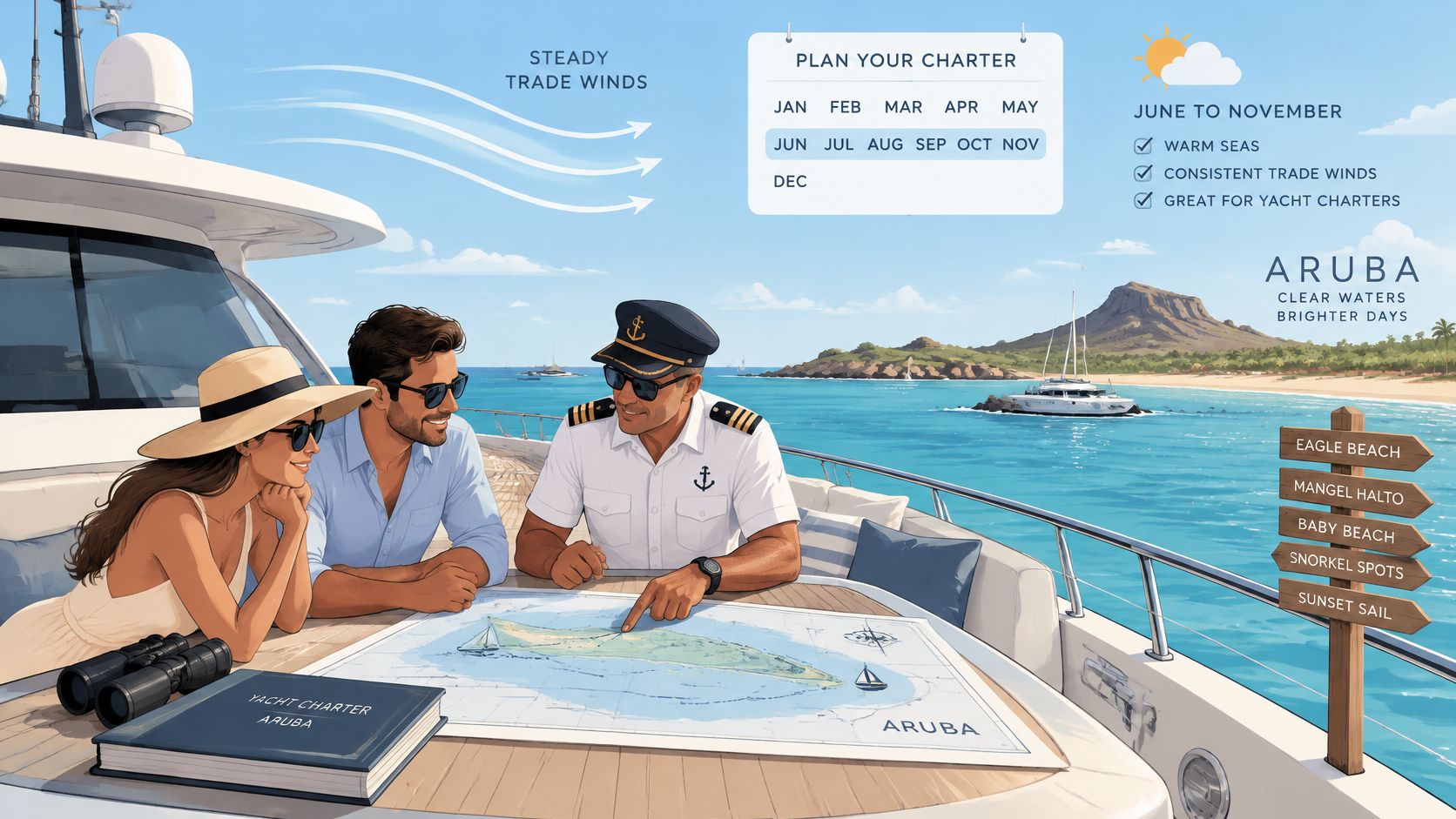
The wind is the more constant factor. Trade winds blow mainly from the east, so the western, leeward coast stays calmer, and that's where most beach stops and swimming bays sit. Build the day around that geometry rather than against it.
A day built for the wind
Start on the sheltered side in the morning while the water is flat and the light is good for snorkeling. Take lunch at a beach with calm water, so guests can swim without the boat rolling. Save the longer swim for late afternoon, when the wind typically eases. Don't schedule the exposed-side run for the middle of the day in high season and expect guests to enjoy it.
Winter, roughly December to April, is the busiest stretch, and availability tightens accordingly. That's the window when booking early matters more than negotiating.
Contingency, in four lines
- Name one alternate beach on the calm side. Decide it before you board, not when the captain is already committed to a heading.
- Reserve a second tender or transfer slot. One shuttle for twelve guests runs longer than anyone expects.
- Mark one stop as weather-flexible. Build the day so it can lose a stop without losing its shape.
- Agree a decision time with the captain, usually the day before, at which the route is either confirmed or switched.
Guests should check the sea state and the forecast on the day, and the captain has the final say on routing. That isn't a formality. The person holding the local forecast and the mooring picture is the one who knows which stop is workable that morning.
The same discipline holds whether you're routing a week in the Caribbean or planning a Lake Como honeymoon: fix the anchor points, then let conditions choose the order.
Deposits, Cancellations and Non-Refundable Charges
Contract terms decide what a charter costs when plans change, and the answer is often the whole deposit. Our own terms are blunt about it: flights, yachts or special events may be 100% non-refundable regardless of the notice period given. Set that against a yacht booking and the implication is plain. Cancel weeks ahead on a peak-season charter and the deposit may not return, because the boat's calendar is the product being sold.
Work through five checks before you sign.
- Ask for the cancellation schedule in writing. You want dates and percentages, not adjectives. If the schedule arrives as a sentence in an email, ask for the clause in the contract.
- Confirm what happens if the weather stops the boat. Some operators refund, some credit the amount to a future date, and some treat it as a guest cancellation. Those are three very different outcomes for the same storm.
- Trace the APA refund. Ask when reconciliation happens, how unused funds are returned, and what happens if the provisioning budget was partly spent before the trip started.
- Check the rule for a changed guest count or an added stop. Both alter the APA, and a larger group arriving late can shift the catering and tender math after the quote is signed.
- Check that your insurance covers this. Trip cancellation cover doesn't automatically extend to yacht charters or to event-linked travel, and the policy needs reading before the deposit moves, not after.
Test the promise: if a term isn't on the signed page, it isn't a term. A verbal assurance about a refund carries no weight once the deposit has cleared.
Three questions get you most of the way with any operator. What is the last date I can cancel, and what exactly do I lose? If conditions keep us at the dock, what happens to my money? And when, and how, does the unused APA come back to me?
Three Aruba Charters Planned Side by Side
Three briefs, three boats, three bills. The totals matter less than watching how far the brief moves them.
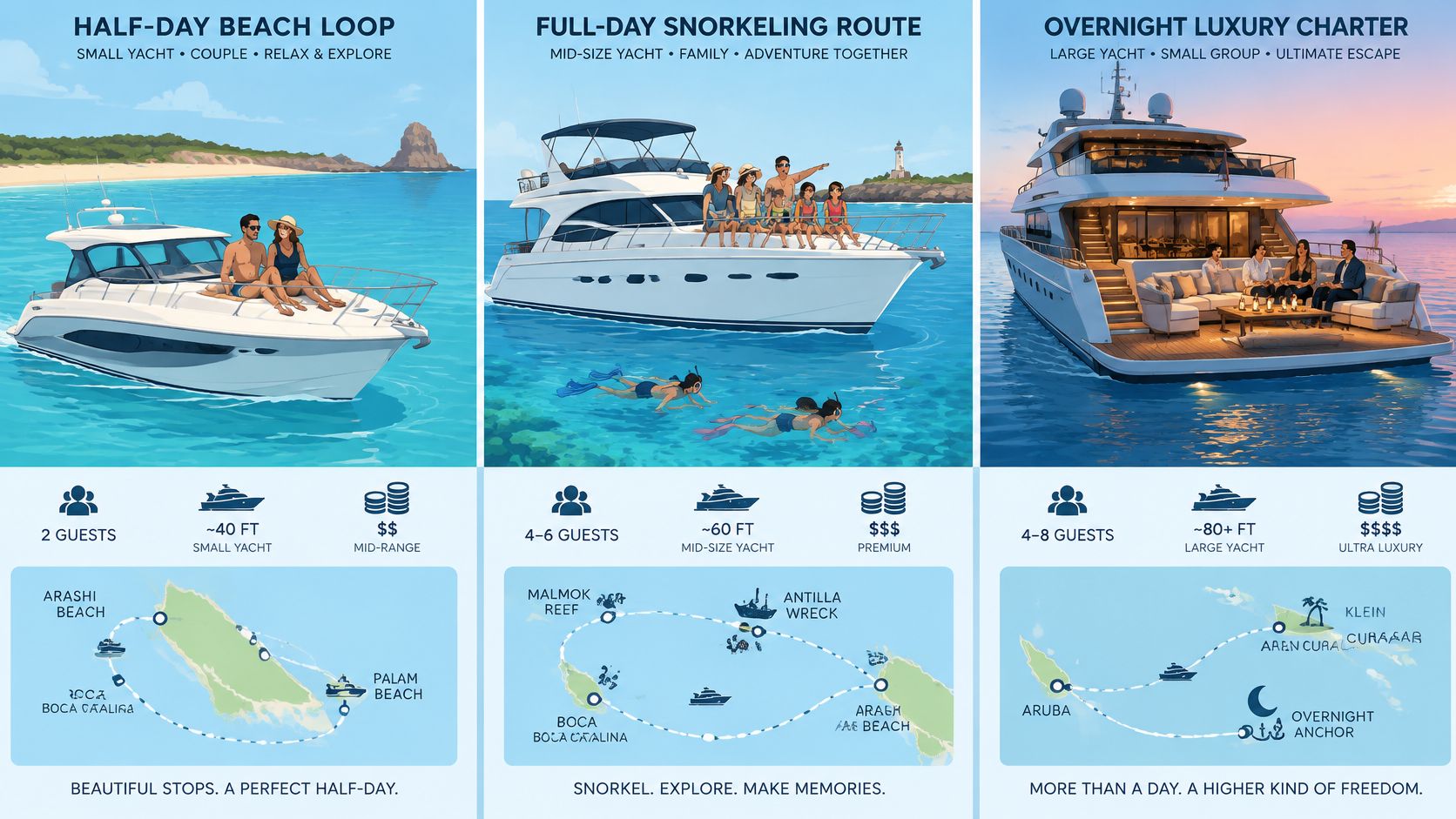
A couple, half a day, two snorkel stops
A smaller yacht, four hours, a loop on the calm western side with two snorkeling stops and a cold lunch aboard. The APA stays modest because fuel burn is modest, the route never leaves sheltered water, and provisioning is lunch for two. A late change of plan is cheap to absorb here, which is the luxury of the short format. This is the booking to make when the charter is one afternoon of a longer island stay.
A family of eight, full day, toys in the water
More cabins, more crew, and a tender running constantly between the yacht and the swimming stops. Fuel and provisioning both climb, and water toys add crew time and stowage load, so the APA sits near the top of its range rather than the middle. The useful question isn't whether a bigger boat is available. It's whether the tender and crew setup handles eight guests and a swim stop every hour without the day turning into a shuttle service.
A corporate group, overnight, dinner for twenty
Event space, a longer lead time, anchorage rules checked before anything is signed, and a fallback marina named in case conditions turn. The dinner is the fixed point and the rest of the itinerary is built to protect it. Catering, crew hours and a second venue contact push this furthest from the advertised rate, and it's the case where a written brief saves the most money.
Costs scale with the brief, so compare each of these against its own itemized quote rather than against another group's total. What all three share is simple: the brief decides the yacht, the yacht decides the cost, and the weather decides the route.
Confirm the Charter Brief Before You Book
Seven items separate a signed charter from a guess, and the whole list fits on one page. Work through them in this order before any deposit moves.
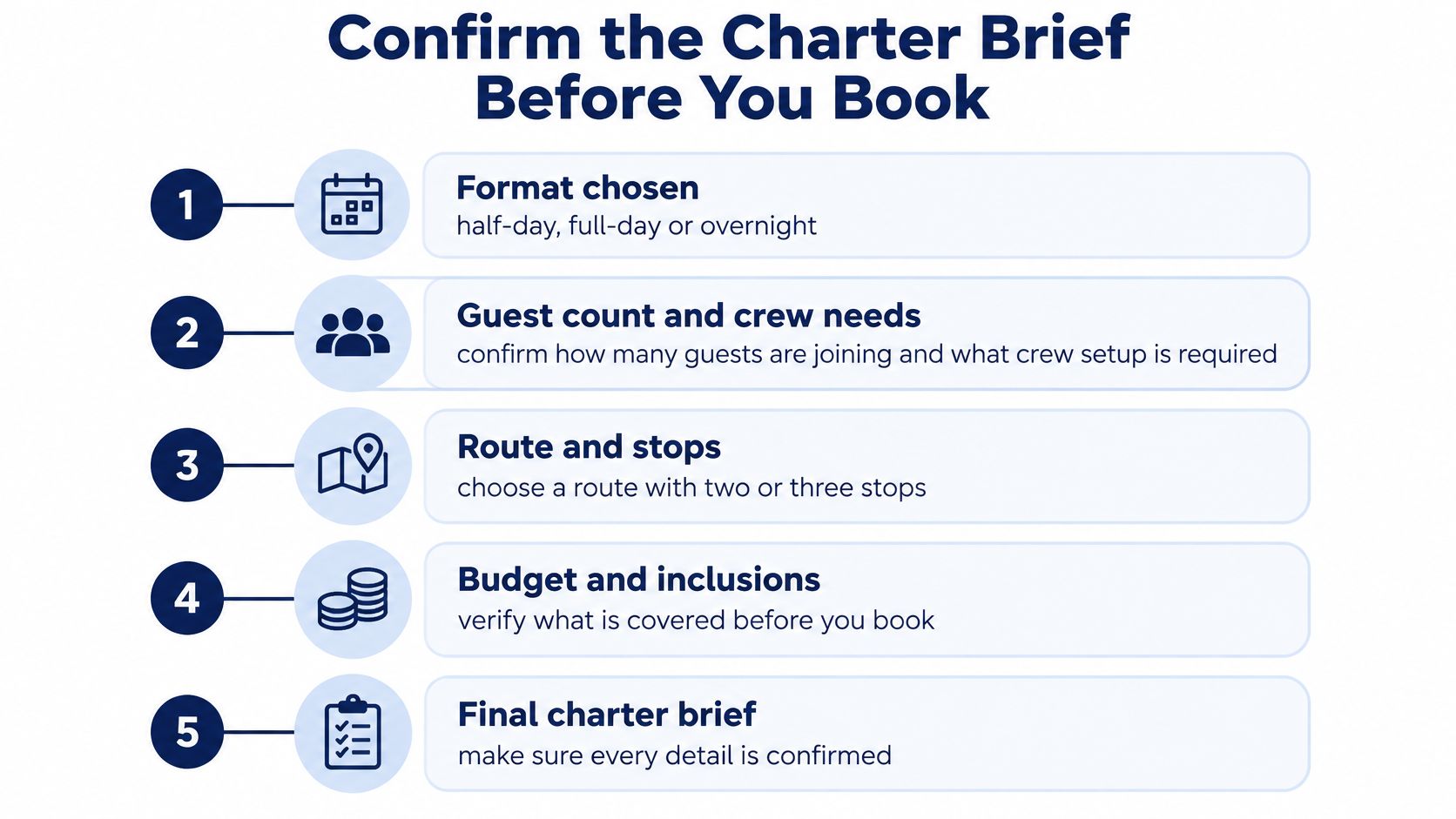
- The format. Half-day, full-day or overnight, written down and agreed.
- Guest count and crew needs. How many are joining, how many cabins that requires, and what crew setup the group needs.
- A route with two or three stops, one of them explicitly flexible.
- A weather fallback with a decision deadline, agreed with the captain for the day before.
- An itemized quote showing the base fee, the APA estimate, the gratuity rule and the taxes.
- Cancellation and APA refund terms in writing, including the weather clause.
- A yacht specification covering cruising speed, nautical miles per day, draft and stabilizers.
Then check the operator, not just the boat. Ask for the vessel's charter licence and any Aruba permits it operates under, the captain's and crew's certifications, and the insurance cover named in the contract. Request the documents rather than a reassurance, because a licence number and a certificate are things you can verify. If a charter company hesitates on any of the seven, treat the hesitation as the answer.
Little Blue Door's supplier network includes yacht charters, private aviation, villas, chauffeurs and experience providers around the world. Every itinerary is created à la carte by the in-house advisors, combining accommodation, private transfers, curated activities and restaurant reservations, with dedicated support from the team throughout. A day on the water can sit inside that wider plan, alongside the villa, the driver and the dinner reservation.
Judge every quote against this checklist, line by line, and book only once the itemized quote and the signed terms match the brief. To have that brief turned into a costed Aruba charter proposal, send your dates and guest list.